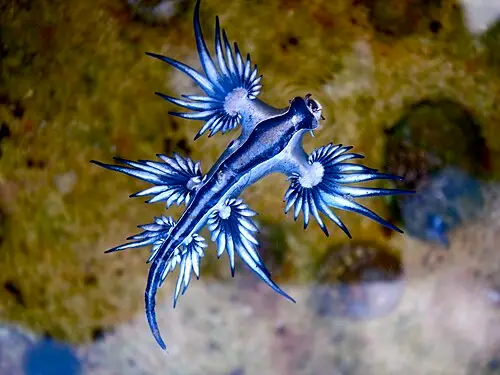
 📸 Photo
Photo: Sylke Rohrlach from Sydney · CC BY-SA 2.0 · Wikimedia Commons Source
Blue dragon
Glaucus atlanticus (Blue dragon · アオミノウミウシ)
Not Evaluated (NE) on the IUCN Red List yet.
💡 Everyday Comparisons for Size, Mass & Speed
- 💡 It is often washed ashore alive on beaches after storms, and because touching it can cause severe indirect envenomation from the stinging cells, it must not be touched on the beach (SeaLifeBase).
- 💡 Its maximum total length of 4 cm is shorter than the short side of a credit card (5.4 cm).
Reference standards: coach bus ~12 m, mid-size car ~4.9 m, compact car ~1 t, basketball hoop 3.05 m, credit card 8.56 cm.
📖 1. Overview
The blue dragon is a small nudibranch (sea slug) that floats upside down at the surface of the open ocean.
🦴 2. Anatomy & Morphology
It swallows air bubbles to adjust its buoyancy and hangs upside down against the surface tension film of the water. Its total length is up to about 4 cm.
🔍 3. Ecology & Behavior
It feeds on siphonophores such as the Portuguese man o' war (Physalia) and stores its prey's stinging cells (nematocysts) in its own body. Being hermaphroditic, individuals mate with each other.
🇰🇷 4. Connection to Korea
No direct record connecting this species to Korea has been found.
📚 Sources & References
- • IUCN Red List: not evaluated (NE) — cross-checked with the Wikidata conservation-status entry
- • marinespecies.org — aphia.php
- • wikidata.org — Q131757
- • commons.wikimedia.org — File:Blue dragon-glaucus atlanticus (8599051974).jpg
- • sealifebase.se — Glaucus-atlanticus.html
- • Silhouette: PhyloPic — Joseba Iza · CC0 1.0
Recorded dimensions are widely cited representative estimates from public literature and may vary by study or specimen.