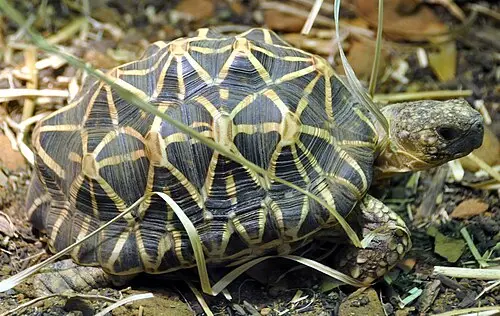
 📸 Photo
Photo: Jacob.jose · CC BY-SA 3.0 · Wikimedia Commons Source
Indian Star Tortoise
Geochelone elegans (Indian Star Tortoise · インドホシガメ)
💡 Everyday Comparisons for Size, Mass & Speed
- 💡 Its maximum length of 38 cm is about 1.3 times the long side of an A4 sheet (about 30 cm), and 6.6 kg is about 2/3 of a 10 kg bag of rice (Comparison).
- 💡 Popular as a pet for its beautiful markings and small size, mass collection for food and the pet trade is driving population declines (benefit to humans noted by ADW).
Reference standards: coach bus ~12 m, mid-size car ~4.9 m, compact car ~1 t, basketball hoop 3.05 m, credit card 8.56 cm.
Site-computed relative index from recorded values; not a formal scientific metric.
📖 1. Overview
The Indian Star Tortoise is a land tortoise living across a wide range of habitats with distinct wet and dry seasons, from moist forests to semi-deserts. Its IUCN status is Vulnerable (VU) as of 2020.
🦴 2. Anatomy & Morphology
On each scute of its carapace, yellow or tan lines radiate from a yellow center to form a star pattern against a brown to black background. Females are often noticeably larger than males.
🔍 3. Ecology & Behavior
It feeds mainly on grasses, leaves, fruits, and flowers, and sometimes eats insects, carrion, or dung. In hot, dry weather it moves only in the early morning and late afternoon, becoming much more active when rain falls and starting to breed with the arrival of the rainy season.
🇰🇷 4. Connection to Korea
No direct record connecting this species to Korea has been found.
📚 Sources & References
- • IUCN Red List VU (2020) — https://www.iucnredlist.org/species/39430/123815345
- • IUCN Red List category VU — latest assessment at iucnredlist.org
- • catalogueoflife.org — 6KC84
- • iucnredlist.org — 123815345
- • wikidata.org — Q846461
- • commons.wikimedia.org — File:Indian star tortoise - Houston Zoo - cropped.jpg
- • animaldiversity.org — Geochelone elegans
- • Silhouette: PhyloPic — Christoph Schomburg · CC0 1.0 (Related taxon silhouette — Gopherus)
Recorded dimensions are widely cited representative estimates from public literature and may vary by study or specimen.