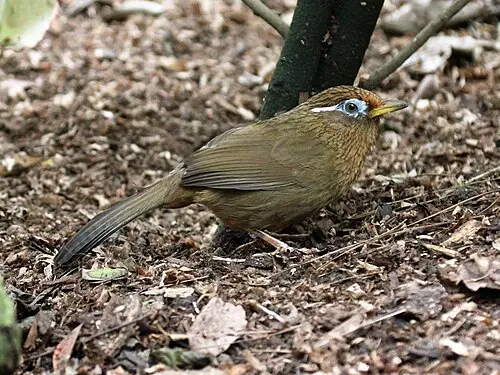
 📸 Photo
Photo: DickDaniels ( http://theworldbirds.org/ ) · CC BY-SA 3.0 · Wikimedia Commons Source
Chinese Hwamei
Garrulax canorus (Chinese Hwamei · ガビチョウ)
💡 Everyday Comparisons for Size, Mass & Speed
- 💡 In Japan, it was an ornamental bird with import records dating back to the Edo period, and after becoming feral it was first observed in Kitakyushu in the 1980s (National Institute for Environmental Studies).
- 💡 It is designated as a "Specified Invasive Alien Species" under Japan's Invasive Alien Species Act (National Institute for Environmental Studies Invasive Species DB).
- 💡 Its total length of 25 cm is about 4 cm longer than the short side of an A4 sheet of paper (21 cm) (Comparison).
Reference standards: coach bus ~12 m, mid-size car ~4.9 m, compact car ~1 t, basketball hoop 3.05 m, credit card 8.56 cm.
📖 1. Overview
The Chinese Hwamei is a melodious songbird native to southern China, Taiwan, and northern Vietnam; in Japan, birds brought in as pets and cage birds have become feral and are managed as an Invasive Alien Species.
🦴 2. Anatomy & Morphology
It is yellowish-brown overall with a white ring around the eye extending backward as a stripe, a gray mid-belly, and fine streaks on the throat and upper breast. Its tail is slightly dark and its bill is yellow.
🔍 3. Ecology & Behavior
It eats insects and fruits, runs well on the ground, and does not fly high. It lives alone or in pairs during the breeding season and forms small flocks outside the breeding season, laying 4 eggs from April to July in its native range.
🇰🇷 4. Connection to Korea
No direct record connecting this species to Korea has been found.
📚 Sources & References
- • IUCN Red List LC (2018) — https://www.iucnredlist.org/species/22735076/132036519
- • IUCN Red List category LC — latest assessment at iucnredlist.org
- • doi.org — avilist.v2026
- • iucnredlist.org — 132036519
- • wikidata.org — Q1589896
- • commons.wikimedia.org — File:Chinese Hwamei RWD.jpg
- • nies.go.jp — 20150.html
- • Silhouette: PhyloPic — Jiekun He · CC0 1.0
Recorded dimensions are widely cited representative estimates from public literature and may vary by study or specimen.