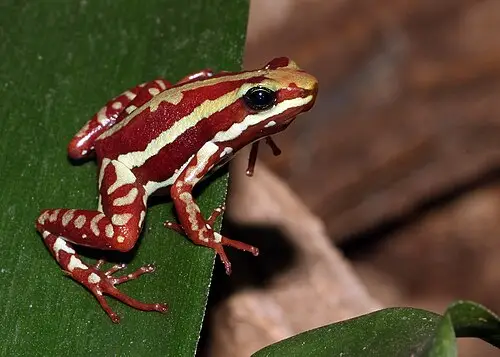
 📸 Photo
Photo: Holger Krisp · CC BY 3.0 · Wikimedia Commons Source
Phantasmal Poison Frog
Epipedobates tricolor (Phantasmal Poison Frog · Phantasmal Poison Frog)
💡 Everyday Comparisons for Size, Mass & Speed
- 💡 The maximum weight of 0.8 g among individuals used in research is nearly the same as a Korean 1-won coin (0.729 g) (Comparison).
- 💡 Toxin-resistance experiments on individuals raised in a laboratory captive-breeding colony calculated that they tolerate doses about 5,000 times higher than the median lethal dose for mice (2026 research paper, preprint).
Reference standards: coach bus ~12 m, mid-size car ~4.9 m, compact car ~1 t, basketball hoop 3.05 m, credit card 8.56 cm.
Site-computed relative index from recorded values; not a formal scientific metric.
📖 1. Overview
The Phantasmal Poison Frog is a poison frog of the genus Epipedobates living in forests on the western slopes of the Andes. Seven species in this genus are known from northern Peru to central Colombia.
🦴 2. Anatomy & Morphology
Poison frogs in the family Dendrobatidae sequester alkaloids from their diet in their skin for defense. This species has amino acid substitutions in its neural receptors that allow it to withstand epibatidine, a potent neurotoxin, and individuals used in research weighed 0.5–0.8 g.
🔍 3. Ecology & Behavior
Ants eaten as prey have been confirmed in the stomachs of wild-caught adults, and alkaloids obtained from ants serve as the source of its skin defense chemicals. In experiments, feeding epibatidine did not affect movement or behavior, showing active resistance across the whole body.
🇰🇷 4. Connection to Korea
No direct record connecting this species to Korea has been found.
📚 Sources & References
- • IUCN Red List VU (2019) — https://www.iucnredlist.org/species/55239/98647137
- • IUCN Red List category VU — latest assessment at iucnredlist.org
- • catalogueoflife.org — 6FVNM
- • iucnredlist.org — 98647137
- • wikidata.org — Q648741
- • commons.wikimedia.org — File:Epipedobates-tricolor-dreistreifen-baumsteiger.jpg
- • pmc.ncbi.nlm.nih.gov — PMC13278156
- • bok.or.kr — contents.do
- • Silhouette: PhyloPic — Andy Wilson · CC0 1.0
Recorded dimensions are widely cited representative estimates from public literature and may vary by study or specimen.