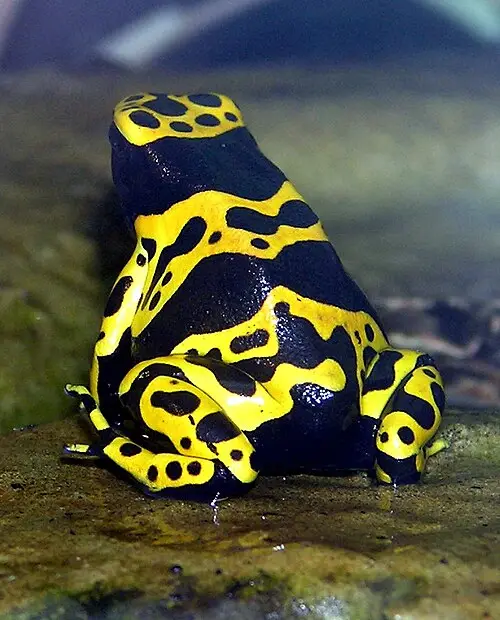
 📸 Photo
Photo: Arpingstone · Public domain · Wikimedia Commons Source
Yellow-banded Poison Frog
Dendrobates leucomelas (Yellow-banded Poison Frog · キオビヤドクガエル)
💡 Everyday Comparisons for Size, Mass & Speed
- 💡 Its average weight of 3 g equals that of two or three Korean 10-won coins (1.22 g), and a body length of 50 mm is similar to two Korean 500-won coins (26.5 mm in diameter) placed side by side (Comparison).
- 💡 Some hobbyists keep and breed this frog, and its skin toxins are studied as a possible source of medicines for diseases (ADW).
Reference standards: coach bus ~12 m, mid-size car ~4.9 m, compact car ~1 t, basketball hoop 3.05 m, credit card 8.56 cm.
Site-computed relative index from recorded values; not a formal scientific metric.
📖 1. Overview
The Yellow-banded Poison Frog is a relatively large poison frog living in hot, humid lowland rainforests, notable for its bold yellow and black bands.
🦴 2. Anatomy & Morphology
With a body length of 31–50 mm, it is large for the genus Dendrobates and has an average weight of 3 g. It has yellow and black bands, with the black bands sometimes breaking into spots as it grows, and sticky pads at the tips of its toes allow it to cling to and climb plants.
🔍 3. Ecology & Behavior
During the day it forages for small insects such as ants, termites, tiny beetles, and crickets, as well as spiders, and it loses its skin toxins when kept in captivity. Males defend territories while calling with chirps and buzzes, and eggs are laid on moist leaves and tended by the male.
🇰🇷 4. Connection to Korea
No direct record connecting this species to Korea has been found.
📚 Sources & References
- • IUCN Red List LC (2023) — https://www.iucnredlist.org/species/55191/61395501
- • IUCN Red List category LC — latest assessment at iucnredlist.org
- • catalogueoflife.org — 34M8X
- • iucnredlist.org — 61395501
- • wikidata.org — Q615690
- • commons.wikimedia.org — File:Yellow-banded.poison.dart.frog.arp.jpg
- • animaldiversity.org — Dendrobates leucomelas
- • bok.or.kr — contents.do
- • Silhouette: PhyloPic — Andy Wilson · CC0 1.0
Recorded dimensions are widely cited representative estimates from public literature and may vary by study or specimen.