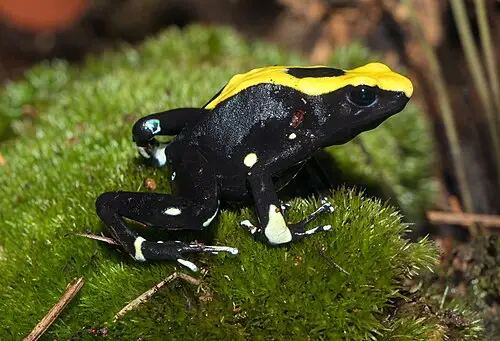
 📸 Photo
Photo: H. Zell · CC BY-SA 3.0 · Wikimedia Commons Source
Dyeing Poison Frog
Dendrobates tinctorius (Dyeing Poison Frog · アイゾメヤドクガエル)
💡 Everyday Comparisons for Size, Mass & Speed
- 💡 Its body length of 5.3 cm is about two-thirds the width of a credit card (about 8.6 cm) (Comparison).
- 💡 Researchers noted that it is widespread in the pet trade and is increasingly used in scientific research.
Reference standards: coach bus ~12 m, mid-size car ~4.9 m, compact car ~1 t, basketball hoop 3.05 m, credit card 8.56 cm.
📖 1. Overview
The Dyeing Poison Frog is a large poison frog with vivid warning colors that represents the Guiana region. It is listed as Least Concern (LC, 2023) on the IUCN Red List.
🦴 2. Anatomy & Morphology
Its skin contains alkaloid toxins, and its body color patterns vary greatly even among individuals. Notably, it does not produce an advertisement call to attract mates.
🔍 3. Ecology & Behavior
Males carry newly hatched tadpoles on their backs to pools of water collected in tree holes or palm bracts. The tadpoles feed on detritus as well as insect and frog larvae.
🇰🇷 4. Connection to Korea
No direct record connecting this species to Korea has been found.
📚 Sources & References
- • IUCN Red List LC (2023) — https://www.iucnredlist.org/species/55204/61395760
- • IUCN Red List category LC — latest assessment at iucnredlist.org
- • catalogueoflife.org — 6CJSY
- • iucnredlist.org — 61395760
- • wikidata.org — Q1478869
- • commons.wikimedia.org — File:Dendrobates tinctorius - Karlsruhe Zoo 05.jpg
- • pmc.ncbi.nlm.nih.gov — PMC6753930
- • doi.org — peerj.7648
- • Silhouette: PhyloPic — Steven Traver · CC0 1.0
Recorded dimensions are widely cited representative estimates from public literature and may vary by study or specimen.