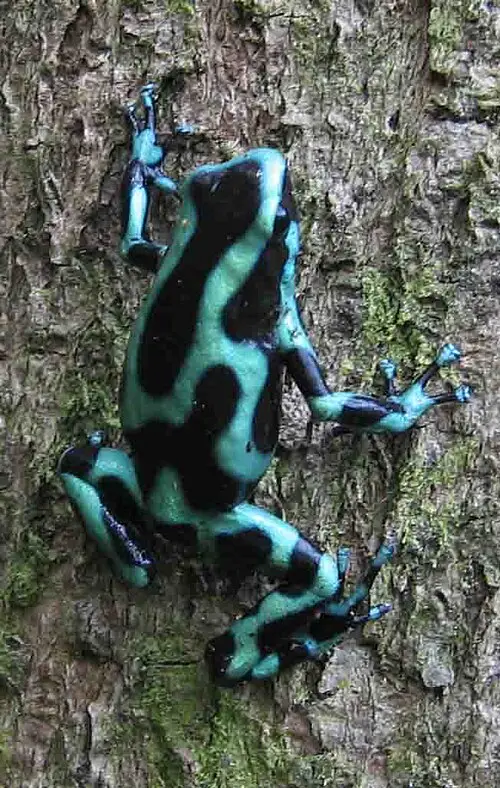
 📸 Photo
Photo: The original uploader was DirkvdM at English Wikipedia . · CC BY 1.0 · Wikimedia Commons Source
Green and Black Poison Frog
Dendrobates auratus (Green and Black Poison Frog · マダラヤドクガエル)
💡 Everyday Comparisons for Size, Mass & Speed
- 💡 A body length of about 4 cm is roughly 1.5 times the diameter of a Korean 500-won coin (26.5 mm) (Comparison).
- 💡 In densely populated areas like Hawaii, eggs are sometimes laid inside broken beer bottles or old cans (ADW).
Reference standards: coach bus ~12 m, mid-size car ~4.9 m, compact car ~1 t, basketball hoop 3.05 m, credit card 8.56 cm.
📖 1. Overview
The Green and Black Poison Frog is a poison frog living beside small streams and pools on the tropical rainforest floor, with an established population in Hawaii as well.
🦴 2. Anatomy & Morphology
Adults measure about 4 cm in body length. Most have green or pale blue bands or spots on a black background, whereas Hawaiian individuals are metallic green or brownish black, and poison glands are distributed across the entire skin surface. Its bright coloration is considered aposematic warning coloration signaling toxicity to visually oriented predators.
🔍 3. Ecology & Behavior
Active during the day, it eats small invertebrates—especially alkaloid-rich ants—and sequesters those toxins in its skin. Fed only alkaloid-free prey, it loses its toxicity; during the rainy season (mid-July to September), males defend territories and call females with trilling sounds, and females lay up to 6 eggs in small pools of water.
🇰🇷 4. Connection to Korea
No direct record connecting this species to Korea has been found.
📚 Sources & References
- • IUCN Red List LC (2020) — https://www.iucnredlist.org/species/55174/3024941
- • IUCN Red List category LC — latest assessment at iucnredlist.org
- • catalogueoflife.org — 34M7L
- • iucnredlist.org — 3024941
- • wikidata.org — Q775199
- • commons.wikimedia.org — File:Poison dart frog panama.jpg
- • animaldiversity.org — Dendrobates auratus
- • bok.or.kr — contents.do
- • Silhouette: PhyloPic — Steven Traver · CC0 1.0 (Congeneric silhouette — Dendrobates tinctorius)
Recorded dimensions are widely cited representative estimates from public literature and may vary by study or specimen.