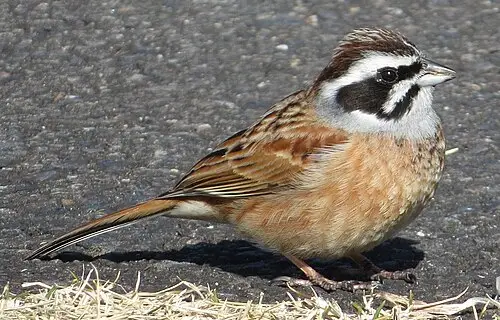
 📸 Photo
Photo: Alpsdake · CC BY-SA 3.0 · Wikimedia Commons Source
Meadow Bunting
Emberiza cioides (Meadow Bunting · ホオジロ)
💡 Everyday Comparisons for Size, Mass & Speed
- 💡 According to the National List of Species of Korea, it is often seen near houses and perches on utility wires to sing, making singing birds easy to observe.
- 💡 Although similar in size and color to Chamsae (a Korean animal name for a sparrow), a closer look shows a longer tail and a white eyebrow stripe, allowing people to tell them apart in the neighborhood.
Reference standards: coach bus ~12 m, mid-size car ~4.9 m, compact car ~1 t, basketball hoop 3.05 m, credit card 8.56 cm.
📖 1. Overview
The meadow bunting is a common resident bird that lives in lowland shrublands, farmlands, and grasslands, so it is often seen around human homes. It is similar in size and color to a sparrow.
🦴 2. Anatomy & Morphology
Its tail is longer than that of Chamsae (a Korean animal name for a sparrow), and its white eyebrow stripe and white outer tail feathers stand out.
🔍 3. Ecology & Behavior
During the breeding season it defends a territory of about 1 ha and sings from conspicuous perches such as shrubs, treetops, and utility wires. It eats weed seeds in winter and insect larvae and adults in summer.
🇰🇷 4. Connection to Korea
The National List of Species of Korea notes that it is a common resident observed nationwide, with some individuals moving to the south coast and Jeju Island for winter.
📚 Sources & References
- • IUCN Red List LC (2024) — https://www.iucnredlist.org/species/22720902/263309780
- • IUCN Red List category LC — latest assessment at iucnredlist.org
- • doi.org — avilist.v2026
- • iucnredlist.org — 263309780
- • 국가생물종목록(국립생물자원관) ktsn 120000002216 — https://species.nibr.go.kr/home/mainHome.do?cont_link=009&subMenu=009002&contCd=009002&ktsn=120000002216
- • wikidata.org — Q1076007
- • commons.wikimedia.org — File:Emberiza cioides male.JPG
- • species.nibr.go.kr — mainHome.do
- • Silhouette: PhyloPic — Ferran Sayol · CC0 1.0 (Congeneric silhouette — Emberiza)
Recorded dimensions are widely cited representative estimates from public literature and may vary by study or specimen.