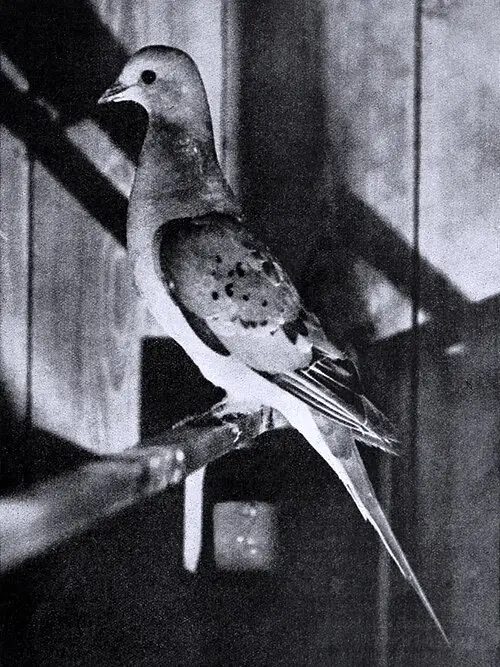
 📸 Photo
Photo: J. G. Hubbard, Internet Archive Book Images · Public domain · Wikimedia Commons Source
Passenger Pigeon
Ectopistes migratorius (Passenger Pigeon · リョコウバト)
💡 Everyday Comparisons for Size, Mass & Speed
- 💡 Its body length of about 41 cm was around 11 cm longer than the long side of an A4 sheet of paper (29.7 cm), and its mass of about 340 g was the weight of five to six chicken eggs (Comparison).
- 💡 The town name 'Pigeon Forge' and the 'Pigeon River' in Tennessee, United States, come from the name of this bird.
- 💡 Trapped with nets and shot in huge numbers for its tasty meat, it is said to have once made up 25–40% of all wild birds in North America.
Reference standards: coach bus ~12 m, mid-size car ~4.9 m, compact car ~1 t, basketball hoop 3.05 m, credit card 8.56 cm.
Site-computed relative index from recorded values; not a formal scientific metric.
📖 1. Overview
The passenger pigeon was once the most abundant bird in North America, darkening the skies in flocks of billions, but hunting and forest destruction drove it to extinction when the last individual, 'Martha,' died in 1914.
🦴 2. Anatomy & Morphology
Its head was slate-blue with a black bill, red eyes, and crimson feet. Its upperparts were grey to blue, the sides and back of the neck were metallic purplish-gold, the throat to breast was reddish-brown, the belly was white, and the tail had 12 feathers. Females were smaller than males.
🔍 3. Ecology & Behavior
It favored beechnuts, acorns, and chestnuts while also eating cherries, wild grapes, earthworms, and grasshoppers, flying 60–80 miles (about 100–130 km) a day in search of food. Nesting in huge colonies with 50–100 nests in a single tree, each pair laid one white egg a year.
🇰🇷 4. Connection to Korea
No direct record connecting this species to Korea has been found.
📚 Sources & References
- • IUCN Red List EX (2019) — https://www.iucnredlist.org/species/22690733/152593137
- • IUCN Red List category EX — latest assessment at iucnredlist.org
- • doi.org — avilist.v2026
- • iucnredlist.org — 152593137
- • wikidata.org — Q191968
- • commons.wikimedia.org — File:Bird lore (1913) (14562557107).jpg
- • pa.gov — passenger-pigeon
- • fws.gov — many-few-none
- • nps.gov — dff10-disappeared from air.htm
- • Silhouette: PhyloPic — RS · CC0 1.0 (Related taxon silhouette — Columbidae)
Recorded dimensions are widely cited representative estimates from public literature and may vary by study or specimen.