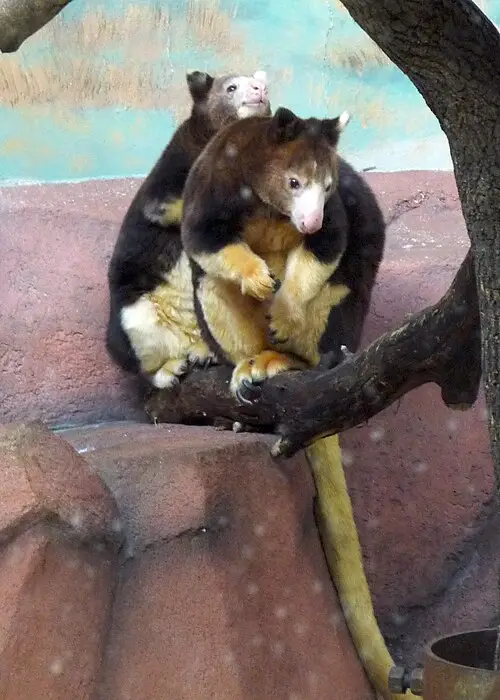
 📸 Photo
Photo: W. Guy Finley · CC BY-SA 2.0 · Wikimedia Commons Source
Huon Tree Kangaroo
Dendrolagus matschiei (Huon Tree Kangaroo · アカキノボリカンガルー)
💡 Everyday Comparisons for Size, Mass & Speed
- 💡 It can leap up to 9 m between trees and drop 18 m to the ground without injury. A height of 18 m is about a 6-story Korean apartment building (at 3 m per floor) (Comparison).
- 💡 Its maximum weight of 13 kg is slightly heavier than a 10 kg bag of rice (Comparison).
Reference standards: coach bus ~12 m, mid-size car ~4.9 m, compact car ~1 t, basketball hoop 3.05 m, credit card 8.56 cm.
Site-computed relative index from recorded values; not a formal scientific metric.
📖 1. Overview
The Huon Tree Kangaroo is an arboreal kangaroo living in the montane forests of the Huon Peninsula in Papua New Guinea.
🦴 2. Anatomy & Morphology
It has a stocky build, a rounded tail as long as its body, and chestnut to reddish-brown fur, while its tail, belly, ear edges, and feet are bright yellow.
🔍 3. Ecology & Behavior
It feeds almost entirely on leaves, preferring mature leaves, and also eats fruits, flowers, nuts, insects, bark, and sap. Females give birth to a single young; the gestation period of 39–45 days is the longest recorded among marsupials, and the young permanently leaves the pouch at about day 350.
🇰🇷 4. Connection to Korea
No direct record connecting this species to Korea has been found.
📚 Sources & References
- • IUCN Red List EN (2016) — https://www.iucnredlist.org/species/6433/21956650
- • IUCN Red List category EN — latest assessment at iucnredlist.org
- • mammaldiversity.org — 1000257
- • iucnredlist.org — 21956650
- • wikidata.org — Q209174
- • commons.wikimedia.org — File:Dendrolagus matschiei -Milwaukee County Zoo-8.jpg
- • animaldiversity.org — Dendrolagus matschiei
- • Silhouette: PhyloPic — Florian Pfaff · Public Domain Mark 1.0 (Congeneric silhouette — Dendrolagus bennettianus)
Recorded dimensions are widely cited representative estimates from public literature and may vary by study or specimen.