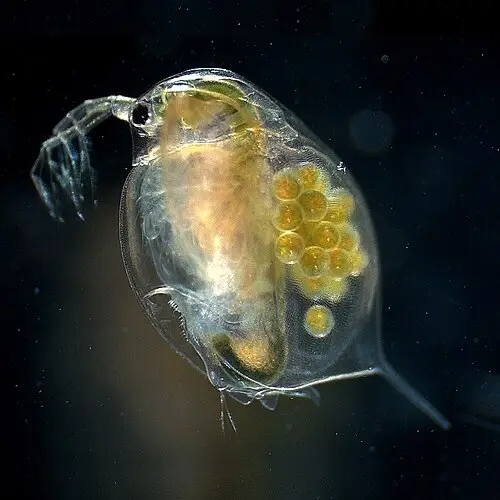
 📸 Photo
Photo: Hajime Watanabe · CC BY 2.5 · Wikimedia Commons Source
Large water flea
Daphnia magna (Large water flea · オオミジンコ)
Not Evaluated (NE) on the IUCN Red List yet.
💡 Everyday Comparisons for Size, Mass & Speed
- 💡 Its maximum body length of 5 mm is equal to the length of a grain of rice (about 5 mm) (Comparison).
- 💡 Animal Diversity Web explains that this water flea eats algae to keep pond and lake water clear, serves as a water-quality indicator organism, and is used in toxicity and pollutant testing. Because it is easy to culture, it is also commonly used as food for aquarium fish.
Reference standards: coach bus ~12 m, mid-size car ~4.9 m, compact car ~1 t, basketball hoop 3.05 m, credit card 8.56 cm.
📖 1. Overview
The large water flea is a small water flea that lives in groups in freshwater lakes, rivers, and temporary pools, and is one of the larger species in the genus Daphnia.
🦴 2. Anatomy & Morphology
Its kidney-bean-shaped body is enclosed in a transparent chitinous carapace, so the color of what it has eaten shows through. It has two pairs of long, branched antennae, and six thoracic appendages inside the carapace create a water current. It has one compound eye and one simple eye.
🔍 3. Ecology & Behavior
It is a filter feeder that uses bristles on its thoracic legs to strain particles smaller than 50 µm, eating phytoplankton, zooplankton, bacteria, and detritus. It rises toward the surface at night to feed and moves down during the day to avoid predators; when conditions are good, females produce clone offspring on their own, and when conditions turn harsh, they mate and form resting egg cases (ephippia).
🇰🇷 4. Connection to Korea
No direct record connecting this species to Korea has been found.
📚 Sources & References
- • IUCN Red List: not evaluated (NE) — cross-checked with the Wikidata conservation-status entry
- • catalogueoflife.org — 6CCSV
- • wikidata.org — Q672531
- • commons.wikimedia.org — File:Daphnia magna-female adult.jpg
- • animaldiversity.org — Daphnia magna
- • Silhouette: PhyloPic — Kamil S. Jaron · CC0 1.0 (Congeneric silhouette — Daphnia)
Recorded dimensions are widely cited representative estimates from public literature and may vary by study or specimen.