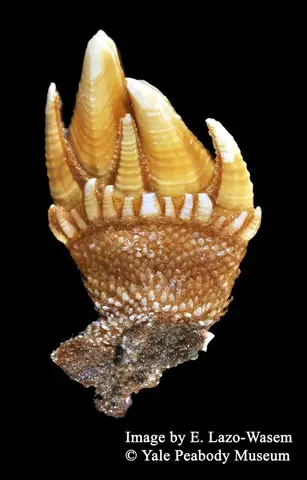
 📸 Photo
Photo: Eric A. Lazo-Wasem · CC0 · Wikimedia Commons Source
Japanese goose barnacle
Capitulum mitella (Japanese goose barnacle · カメノテ)
Not Evaluated (NE) on the IUCN Red List yet.
💡 Everyday Comparisons for Size, Mass & Speed
- 💡 A related goose barnacle, Pollicipes pollicipes, is eaten as an expensive delicacy in Portugal and Spain.
- 💡 In a Korean study, the muscle of the Japanese goose barnacle was analyzed at 15.1% protein and 3.31% lipid, and it is treated as an edible seafood.
Reference standards: coach bus ~12 m, mid-size car ~4.9 m, compact car ~1 t, basketball hoop 3.05 m, credit card 8.56 cm.
📖 1. Overview
The Japanese goose barnacle is a sessile crustacean (barnacle group) attached to intertidal rocks, distributed from the Indian Ocean to the western Pacific.
🦴 2. Anatomy & Morphology
Most individuals are hermaphroditic, so fertilization takes place inside the mantle cavity enclosing the body, and a species of ribbon worm always lives attached inside this mantle cavity.
🔍 3. Ecology & Behavior
It stays attached to rocks without moving around and filter-feeds on particles in the water. Eggs hatch inside the mantle cavity and emerge as free-swimming larvae, passing through 6 nauplius stages to become non-feeding cypris larvae before settling on rocks and maturing into adults.
🇰🇷 4. Connection to Korea
Korean researchers (Korean Journal of Fisheries and Aquatic Sciences, 2016) wrote that the Japanese goose barnacle is a less popularized food ingredient in Korea. In the same study, its muscle was analyzed as 15.1% protein and 3.31% lipid.
📚 Sources & References
- • IUCN Red List: not evaluated (NE) — cross-checked with the Wikidata conservation-status entry
- • marinespecies.org — aphia.php
- • 국가생물종목록(국립생물자원관) ktsn 120000515174 — https://species.nibr.go.kr/home/mainHome.do?cont_link=009&subMenu=009002&contCd=009002&ktsn=120000515174
- • wikidata.org — Q5035994
- • commons.wikimedia.org — File:Capitulum mitella (YPM IZ 049075).jpeg
- • sealifebase.se — Capitulum-mitella.html
- • scholarworks.gnu.ac.kr — 16054
Recorded dimensions are widely cited representative estimates from public literature and may vary by study or specimen.