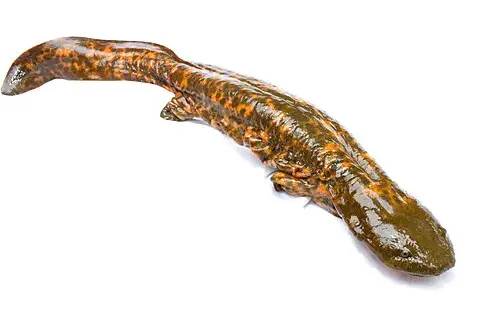
 📸 Photo
Photo: Brian Gratwicke · CC BY 2.0 · Wikimedia Commons Source
Hellbender
Cryptobranchus alleganiensis (Hellbender · ヘルベンダー)
💡 Everyday Comparisons for Size, Mass & Speed
- 💡 A body length of 69 cm is slightly longer than a folded umbrella (about 60 cm) (Comparison).
- 💡 Because it cannot survive in polluted water, it serves as a bioindicator of stream water quality (ADW, 'Economic Importance for Humans: Positive').
- 💡 At the Smithsonian's National Zoo, hellbenders are fed crayfish, shrimp, smelt, and earthworms.
Reference standards: coach bus ~12 m, mid-size car ~4.9 m, compact car ~1 t, basketball hoop 3.05 m, credit card 8.56 cm.
Site-computed relative index from recorded values; not a formal scientific metric.
📖 1. Overview
The Hellbender is the largest aquatic salamander in North America, living beneath large rocks on the beds of clear, flowing streams in the eastern United States. It is listed as Vulnerable (VU, assessed in 2022) on the IUCN Red List.
🦴 2. Anatomy & Morphology
Measuring 295–686 mm in body length and weighing 405–1,010 g, it has a flattened body with loose skin folds that increase surface area for cutaneous respiration. Its head is very flat, it lacks eyelids and feathery external gills, and its muscular tail provides the main propulsion for swimming.
🔍 3. Ecology & Behavior
Adults feed primarily on crayfish as well as insects, fish, and smaller salamanders, foraging along streambeds at night and using suction feeding to pull crayfish from the mud. By day it hides beneath a large rock and defends the area around that rock as its territory, acting aggressively toward intruders outside the breeding season.
🇰🇷 4. Connection to Korea
No direct record connecting this species to Korea has been found.
📚 Sources & References
- • IUCN Red List VU (2022) — https://www.iucnredlist.org/species/59077/82473431
- • IUCN Red List category VU — latest assessment at iucnredlist.org
- • catalogueoflife.org — 6BKKP
- • iucnredlist.org — 82473431
- • wikidata.org — Q369467
- • commons.wikimedia.org — File:Hellbender.jpg
- • animaldiversity.org — Cryptobranchus alleganiensis
- • nationalzoo.si.edu — hellbender
- • Silhouette: PhyloPic — Y. de Hoev. (vectorized by T. Michael Keesey) · Public Domain Mark 1.0 (Related taxon silhouette — Andrias japonicus)
Recorded dimensions are widely cited representative estimates from public literature and may vary by study or specimen.