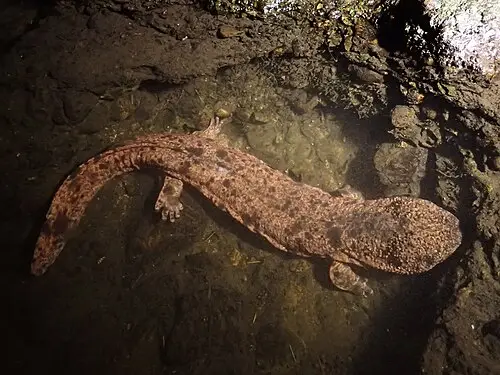
 📸 Photo
Photo: Salamandra2021 · CC BY-SA 4.0 · Wikimedia Commons Source
Japanese Giant Salamander
Andrias japonicus (Japanese Giant Salamander · オオサンショウウオ)
💡 Everyday Comparisons for Size, Mass & Speed
- 💡 A body length of 1.5 m is slightly shorter than an adult human's height (about 1.7 m) (Comparison).
- 💡 A weight of 25 kg is 5 kg heavier than a 20 kg bag of rice (Comparison).
Reference standards: coach bus ~12 m, mid-size car ~4.9 m, compact car ~1 t, basketball hoop 3.05 m, credit card 8.56 cm.
Site-computed relative index from recorded values; not a formal scientific metric.
📖 1. Overview
The Japanese giant salamander is a large salamander living only in northern Kyushu and western Honshu in Japan. On the IUCN Red List, it was assessed as Vulnerable (VU, 2022).
🦴 2. Anatomy & Morphology
It is a large salamander reaching a body length of about 1.5 m and a weight of up to 25 kg.
🔍 3. Ecology & Behavior
It feeds on fish, insects, crustaceans, and earthworms. Breeding usually begins in early August (month 8); after a female lays 400–500 eggs in a spawning burrow, the male guards them, and they hatch after 12–15 weeks.
🇰🇷 4. Connection to Korea
No direct record connecting this species to Korea has been found.
📚 Sources & References
- • IUCN Red List VU (2022) — https://www.iucnredlist.org/species/1273/177177761
- • IUCN Red List category VU — latest assessment at iucnredlist.org
- • catalogueoflife.org — DTJR
- • iucnredlist.org — 177177761
- • wikidata.org — Q112045
- • commons.wikimedia.org — File:Japanese giant salamander in Tottori Prefecture, Japan.
- • animaldiversity.org — Andrias japonicus
- • Silhouette: PhyloPic — Y. de Hoev. (vectorized by T. Michael Keesey) · Public Domain Mark 1.0
Recorded dimensions are widely cited representative estimates from public literature and may vary by study or specimen.