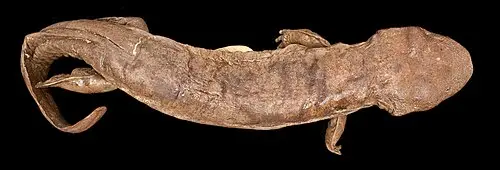
 📸 Photo
Photo: Samuel T. Turvey, Melissa M. Marr, Ian Barnes , Selina Brace, Benjamin Tapley, Robert W. Murphy, Ermi Zhao, Andrew A. Cunningham · CC BY 4.0 · Wikimedia Commons Source
South China Giant Salamander
Andrias sligoi (South China Giant Salamander · South China Giant Salamander)
💡 Everyday Comparisons for Size, Mass & Speed
- 💡 A weight of 23.4 kg is heavier than a 20 kg bag of rice, and a length of 1.375 m is about two adult paces (Comparison).
- 💡 In Japan, introduced Chinese Giant Salamanders have caused hybridization problems with the native Japanese Giant Salamander (Andrias japonicus), and during genetic testing for that issue the South China Giant Salamander was discovered by chance (Scientific Reports).
Reference standards: coach bus ~12 m, mid-size car ~4.9 m, compact car ~1 t, basketball hoop 3.05 m, credit card 8.56 cm.
Site-computed relative index from recorded values; not a formal scientific metric.
📖 1. Overview
The South China Giant Salamander, only recently distinguished as a separate species from the Chinese Giant Salamander, is one of the largest amphibians in the world and is nearly extinct in the wild. It is listed as Critically Endangered (CR, 2023 assessment) on the IUCN Red List.
🦴 2. Anatomy & Morphology
Four individuals confirmed in Japan measured 1,100–1,375 mm in total length. One preserved specimen had a snout-vent length of 698 mm out of a total length of 1,115 mm, with the tail making up 60% of that length.
🔍 3. Ecology & Behavior
Wild populations declined sharply due to habitat destruction and overharvesting for food and traditional medicine, leaving the species nearly extinct by the time it was re-recognized. In Japan, individuals apparently brought from China are kept in captivity, and some suggest these individuals could now serve as a 'survival ark' for this endangered species.
🇰🇷 4. Connection to Korea
No direct record connecting this species to Korea has been found.
📚 Sources & References
- • IUCN Red List CR (2023) — https://www.iucnredlist.org/species/179010130
- • IUCN Red List category CR — latest assessment at iucnredlist.org
- • catalogueoflife.org — LQGLJ
- • iucnredlist.org — 179010130
- • wikidata.org — Q67817252
- • commons.wikimedia.org — File:Andrias sligoi holotype (BMNH 1945.11.7.1), dorsal view
- • pmc.ncbi.nlm.nih.gov — PMC10831114
- • Silhouette: PhyloPic — Y. de Hoev. (vectorized by T. Michael Keesey) · Public Domain Mark 1.0 (Congeneric silhouette — Andrias japonicus)
Recorded dimensions are widely cited representative estimates from public literature and may vary by study or specimen.