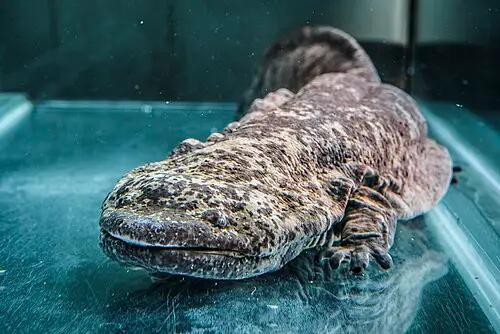
 📸 Photo
Photo: Petr Hamerník · CC BY-SA 4.0 · Wikimedia Commons Source
Chinese Giant Salamander
Andrias davidianus (Chinese Giant Salamander · チュウゴクオオサンショウウオ)
💡 Everyday Comparisons for Size, Mass & Speed
- 💡 A weight of 11 kg is slightly heavier than a 10 kg bag of rice, and a length of 1 m is the length of a 1 m ruler (Comparison).
- 💡 In China it is used as a delicacy and medicine, leading to both poaching and farming, and the acidic skin secretion it uses to repel predators is also used in traditional medicine (positive impacts on humans in ADW).
Reference standards: coach bus ~12 m, mid-size car ~4.9 m, compact car ~1 t, basketball hoop 3.05 m, credit card 8.56 cm.
Site-computed relative index from recorded values; not a formal scientific metric.
📖 1. Overview
The Chinese Giant Salamander is the largest living amphibian species, inhabiting clear, fast-flowing mountain streams in China. It is listed as Critically Endangered (CR, 2023 assessment) on the IUCN Red List.
🦴 2. Anatomy & Morphology
It averages 1 m in length and about 11 kg in weight, with individuals up to 1.8 m recorded in the past. It has a flat, stout body with short limbs, a dorsal fin fold, a tail making up 59% of total length, small lidless eyes, and a wide arched mouth.
🔍 3. Ecology & Behavior
A nocturnal, territorial ambush hunter, it eats crabs, frogs, water shrews, and fish by opening its mouth to suck in water, and also cannibalizes its own kind, with conspecifics reported to make up 27% of its diet by weight. Males claim cave-like dens in month 8, push out sand and gravel to clean them and attract females, and breed yearly.
🇰🇷 4. Connection to Korea
No direct record connecting this species to Korea has been found.
📚 Sources & References
- • IUCN Red List CR (2023) — https://www.iucnredlist.org/species/179010104/48438418
- • IUCN Red List category CR — latest assessment at iucnredlist.org
- • catalogueoflife.org — DTJQ
- • iucnredlist.org — 48438418
- • wikidata.org — Q61312
- • commons.wikimedia.org — File:Velemlok čínský zoo praha 1.jpg
- • animaldiversity.org — Andrias davidianus
- • Silhouette: PhyloPic — Chuanixn Yu · CC0 1.0
Recorded dimensions are widely cited representative estimates from public literature and may vary by study or specimen.