 📸 Photo
Photo: SandyCole ( mailto:sandyc@dicksandy.org ) · CC BY-SA 3.0 · Wikimedia Commons Source
Great Blue Turaco
Corythaeola cristata (Great Blue Turaco · カンムリエボシドリ)
💡 Everyday Comparisons for Size, Mass & Speed
- 💡 Its maximum body length of 76 cm is three-quarters (3/4) of a 1 m ruler, and its maximum mass of 1.2 kg is lighter than one 1.5 L bottle of water (Comparison).
- 💡 A 5-year study in a home garden in Kenya recorded it picking fruits such as loquats and guavas, swallowing small guavas whole.
- 💡 It has been observed flying low, skimming just over tea bushes to cross tea plantations.
Reference standards: coach bus ~12 m, mid-size car ~4.9 m, compact car ~1 t, basketball hoop 3.05 m, credit card 8.56 cm.
Site-computed relative index from recorded values; not a formal scientific metric.
📖 1. Overview
The great blue turaco is the largest bird among the turacos, living in flocks in the forest canopy of West and Central Africa. It has the widest distribution of any turaco.
🦴 2. Anatomy & Morphology
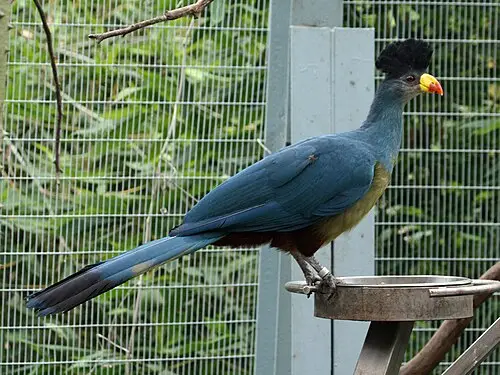
Its head is turquoise-blue with a bluish-black crest on the crown, and its large curved yellow bill is tipped with red. Its upperparts and tail are turquoise-blue with a broad black band near the tip of the tail, and its lower belly is reddish-brown. Males and females look alike.
🔍 3. Ecology & Behavior
It mainly eats fruit along with shoots, leaves, and flowers; in a study in Kenya, it was not seen eating insects. It moves in flocks of 6–18 birds, and male and female together build a stick platform nest in a tall tree and incubate 2 round blue eggs for up to 31 days.
🇰🇷 4. Connection to Korea
No direct record connecting this species to Korea has been found.
📚 Sources & References
- • IUCN Red List LC (2024) — https://www.iucnredlist.org/species/22688425/264142930
- • IUCN Red List category LC — latest assessment at iucnredlist.org
- • doi.org — avilist.v2026
- • iucnredlist.org — 264142930
- • wikidata.org — Q847182
- • commons.wikimedia.org — File:Great Blue Turaco SMTC.jpg
- • dwazoo.com — great-blue-turaco
- • zenodo.org — content
- • Silhouette: PhyloPic — Kai Caspar · CC0 1.0
Recorded dimensions are widely cited representative estimates from public literature and may vary by study or specimen.