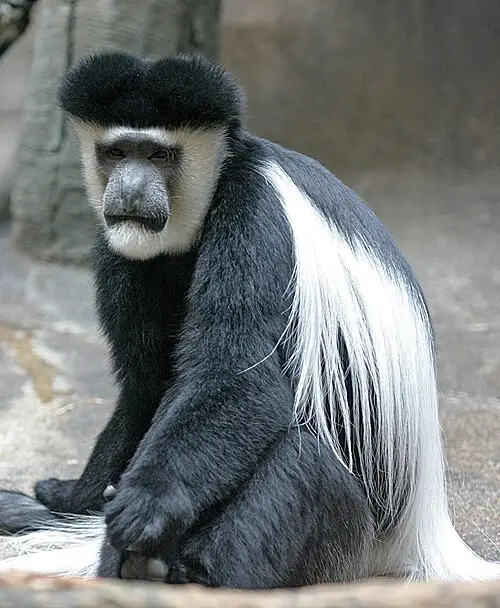
 📸 Photo
Photo: en:User:Cburnett · CC BY-SA 3.0 · Wikimedia Commons Source
Guereza
Colobus guereza (Guereza · アビシニアコロブス)
💡 Everyday Comparisons for Size, Mass & Speed
- 💡 Its maximum weight of 14 kg is about 70% of a 20 kg bag of rice (Comparison).
- 💡 It has been used in research on human disease, behavior, and physiology, including studies examining the effects of rickets caused by vitamin D deficiency (ADW human benefits).
Reference standards: coach bus ~12 m, mid-size car ~4.9 m, compact car ~1 t, basketball hoop 3.05 m, credit card 8.56 cm.
Site-computed relative index from recorded values; not a formal scientific metric.
📖 1. Overview
The Guereza is an arboreal, leaf-eating monkey of African forests, with a long tail and a sturdy build.
🦴 2. Anatomy & Morphology
It has only four fingers on each hand, with the thumb absent or reduced to a tiny nub, an adaptation explained as suited for swinging quickly through the trees. It lacks cheek pouches and has prominent ischial callosities on its rump.
🔍 3. Ecology & Behavior
It feeds mainly on leaves, with young tender leaves making up about 58% of its diet. It usually lives in troops of 8 to 15 individuals consisting of one adult male, three or four females, and their offspring.
🇰🇷 4. Connection to Korea
No direct record connecting this species to Korea has been found.
📚 Sources & References
- • IUCN Red List LC (2025) — https://www.iucnredlist.org/species/5143/254878093
- • IUCN Red List category LC — latest assessment at iucnredlist.org
- • mammaldiversity.org — 1000637
- • iucnredlist.org — 254878093
- • wikidata.org — Q628239
- • commons.wikimedia.org — File:Mantled Guereza.jpg
- • animaldiversity.org — Colobus guereza
- • Silhouette: PhyloPic — Yan Wong from drawing in The Century Dictionary (1911) · CC0 1.0
Recorded dimensions are widely cited representative estimates from public literature and may vary by study or specimen.