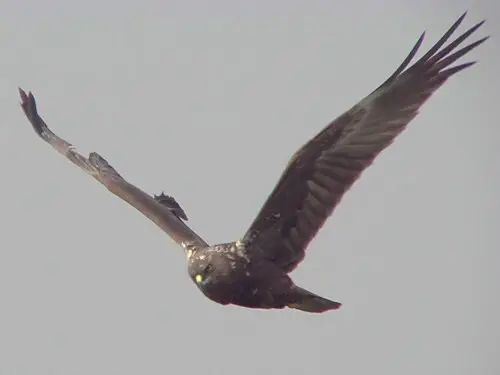
 📸 Photo
Photo: Charles Lam from Hong Kong, China · CC BY-SA 2.0 · Wikimedia Commons Source
Eastern Marsh Harrier
Circus spilonotus (Eastern Marsh Harrier · チュウヒ)
🇰🇷 Natural Monument (Korea) «Eastern Marsh Harrier»
💡 Everyday Comparisons for Size, Mass & Speed
- 💡 The 48–56 cm body length of harriers is about 1.6–1.9 times the long side of an A4 sheet of paper (29.7 cm) (Comparison, combined value for the three species).
- 💡 Because it is a Natural Monument (Korea), it is protected and cannot be caught or kept without a permit.
Reference standards: coach bus ~12 m, mid-size car ~4.9 m, compact car ~1 t, basketball hoop 3.05 m, credit card 8.56 cm.
📖 1. Overview
The eastern marsh harrier is a medium-sized bird of prey living in East Asian wetlands and reedbeds, and is a very rare winter visitor in Korea.
🦴 2. Anatomy & Morphology
The Korea Heritage Service groups the eastern marsh harrier, hen harrier, and pied harrier together as harriers with body lengths of 48–56 cm, and no separate measurement for this species alone was found.
🔍 3. Ecology & Behavior
Three harrier species—the eastern marsh harrier, hen harrier, and pied harrier—visit Korea, and among them the eastern marsh harrier is described as a species very rarely seen in winter.
🇰🇷 4. Connection to Korea
In Korea, it was designated a Natural Monument (Korea) on November 16, 1982 (1982-11-16) and is a bird very rarely observed in winter.
📚 Sources & References
- • IUCN Red List LC (2021) — https://www.iucnredlist.org/species/61709141/203625947
- • 천연기념물 «개구리매» — 국가생물종목록(국립생물자원관) ktsn 120000001598 — https://species.nibr.go.kr/home/mainHome.do?cont_link=009&subMenu=009002&contCd=009002&ktsn=120000001598
- • IUCN Red List category LC — latest assessment at iucnredlist.org
- • Korean protection status: Natural Monument (Korea) «Eastern Marsh Harrier»
- • doi.org — avilist.v2026
- • iucnredlist.org — 203625947
- • 국가생물종목록(국립생물자원관) ktsn 120000001598 — https://species.nibr.go.kr/home/mainHome.do?cont_link=009&subMenu=009002&contCd=009002&ktsn=120000001598
- • heritage.go.kr — culSelectDetail.do
- • wikidata.org — Q1269372
- • commons.wikimedia.org — File:Circus spilonotus.jpg
- • species.nibr.go.kr — mainHome.do
- • Silhouette: PhyloPic — Shyamal · CC BY 3.0 (Congeneric silhouette — Circus)
Recorded dimensions are widely cited representative estimates from public literature and may vary by study or specimen.