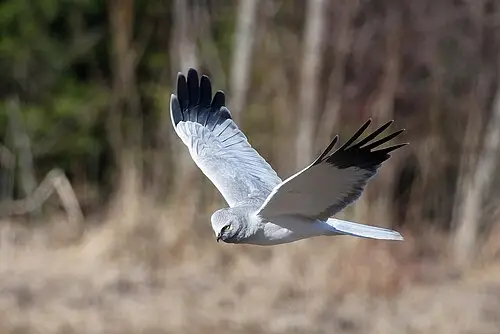
 📸 Photo
Photo: Александр Чегодаев · CC0 · Wikimedia Commons Source
Hen Harrier
Circus cyaneus (Hen Harrier · ハイイロチュウヒ)
🇰🇷 Class II endangered wildlife (Korea) · Natural Monument (Korea) «Hen Harrier»
💡 Everyday Comparisons for Size, Mass & Speed
- 💡 It is a bird that mainly preys on voles in rice paddies, fields, and meadows.
- 💡 Its maximum body length of 50 cm is about 1.7 times the long side of an A4 sheet of paper (29.7 cm) (Comparison).
- 💡 Its maximum wingspan of 1.21 m is longer than a 1 m ruler (Comparison).
Reference standards: coach bus ~12 m, mid-size car ~4.9 m, compact car ~1 t, basketball hoop 3.05 m, credit card 8.56 cm.
Site-computed relative index from recorded values; not a formal scientific metric.
📖 1. Overview
The hen harrier is a medium-sized bird of prey that hunts by flying low over open fields and wetlands of the Northern Hemisphere.
🦴 2. Anatomy & Morphology
Feathers form a facial disc that funnels sound to its ears to locate prey, and in flight it holds its wings in a shallow V and shows a white rump patch. Males are pale grey and females are brown.
🔍 3. Ecology & Behavior
It feeds mostly on small mammals such as voles while also catching snakes, frogs, and small birds, and builds its nest on the ground where it lays 3–5 eggs. It flies low before dropping down to seize prey.
🇰🇷 4. Connection to Korea
In Korea, it is a winter visitor found around wetlands and farmlands, designated as Class II endangered wildlife (Korea) and, on November 16, 1982 (1982-11-16), as a Natural Monument (Korea).
📚 Sources & References
- • IUCN Red List LC (2021) — https://www.iucnredlist.org/species/22727733/200497981
- • 멸종위기 야생생물 Ⅱ급 · 천연기념물 «잿빛개구리매» — 국가생물종목록(국립생물자원관) ktsn 120000001599 — https://species.nibr.go.kr/home/mainHome.do?cont_link=009&subMenu=009002&contCd=009002&ktsn=120000001599
- • IUCN Red List category LC — latest assessment at iucnredlist.org
- • Korean protection status: Class II endangered wildlife (Korea) · Natural Monument (Korea) «Hen Harrier»
- • doi.org — avilist.v2026
- • iucnredlist.org — 200497981
- • 국가생물종목록(국립생물자원관) ktsn 120000001599 — https://species.nibr.go.kr/home/mainHome.do?cont_link=009&subMenu=009002&contCd=009002&ktsn=120000001599
- • heritage.go.kr — culSelectDetail.do
- • wikidata.org — Q25572
- • commons.wikimedia.org — File:Circus cyaneus 265961899.jpg
- • nie.re.kr — view.do
- • animaldiversity.org — Circus cyaneus
- • peregrinefund.org — northern-harrier
- • Silhouette: PhyloPic — Andy Wilson · CC0 1.0
Recorded dimensions are widely cited representative estimates from public literature and may vary by study or specimen.