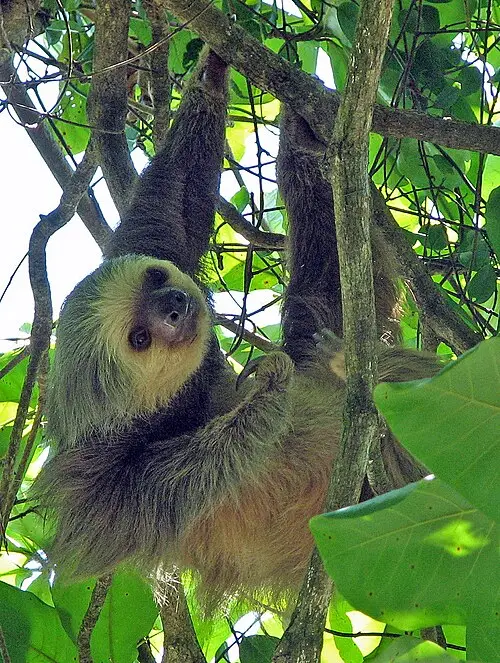
 📸 Photo
Photo: derivative work: Stevenj ( talk ) Original photo by Leyo . · CC BY 2.5 · Wikimedia Commons Source
Hoffmann's Two-toed Sloth
Choloepus hoffmanni (Hoffmann's Two-toed Sloth · ホフマンナマケモノ)
💡 Everyday Comparisons for Size, Mass & Speed
- 💡 A head and body length of 70 cm equals two and a half 30 cm rulers, and its daily food intake of 0.35 kg is slightly less than a loaf of sliced bread (Comparison).
- 💡 In Central and South America, it serves as a flagship animal for ecotourism, drawing visitors who come to see this sloth.
Reference standards: coach bus ~12 m, mid-size car ~4.9 m, compact car ~1 t, basketball hoop 3.05 m, credit card 8.56 cm.
Site-computed relative index from recorded values; not a formal scientific metric.
📖 1. Overview
Hoffmann's Two-toed Sloth is one of the two species of two-toed sloths with 2 claws on the forefeet, eating, sleeping, and giving birth in the continuous forest canopy. It lives mostly alone.
🦴 2. Anatomy & Morphology
Its head is rounded with a flat face and a small hairless nose. Its ears are round and thick, almost hidden in the fur, and adults have a mottled coat mixing tan, gold, and light brown.
🔍 3. Ecology & Behavior
It feeds on leaves, buds, young shoots, fruits, and flowers, eating an average of 0.35 kg per day. Its digestion rate is the slowest among herbivorous mammals; like ruminants, it has a four-chambered stomach and is active at night.
🇰🇷 4. Connection to Korea
No direct record connecting this species to Korea has been found.
📚 Sources & References
- • IUCN Red List LC (2022) — https://www.iucnredlist.org/species/4778/210443596
- • IUCN Red List category LC — latest assessment at iucnredlist.org
- • mammaldiversity.org — 1000434
- • iucnredlist.org — 210443596
- • wikidata.org — Q1052814
- • commons.wikimedia.org — File:Two-toed sloth Costa Rica - cropped.jpg
- • animaldiversity.org — Choloepus hoffmanni
- • Silhouette: PhyloPic — Xavier A. Jenkins · CC0 1.0 (Congeneric silhouette — Choloepus)
Recorded dimensions are widely cited representative estimates from public literature and may vary by study or specimen.