 📸 Photo
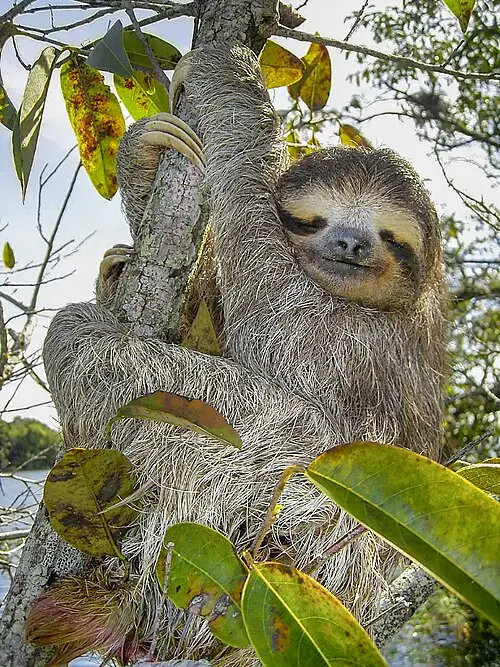
Photo: Stefan Laube ( Tauchgurke ) · Public domain · Wikimedia Commons Source
Brown-throated Three-toed Sloth
Bradypus variegatus (Brown-throated Three-toed Sloth · ノドチャミユビナマケモノ)
💡 Everyday Comparisons for Size, Mass & Speed
- 💡 Its maximum weight of 5.19 kg is just over half of a 10 kg bag of rice, and its average length of 60 cm equals two 30 cm rulers (Comparison).
- 💡 Sleeping 14–16 hours out of every 24 hours means it spends well over half of each day asleep (Comparison).
Reference standards: coach bus ~12 m, mid-size car ~4.9 m, compact car ~1 t, basketball hoop 3.05 m, credit card 8.56 cm.
Site-computed relative index from recorded values; not a formal scientific metric.
📖 1. Overview
The brown-throated three-toed sloth hangs upside down in the trees of Central and South American forests and has a brown throat and head. Although a capable swimmer, it rarely comes down to the ground.
🦴 2. Anatomy & Morphology
Its coat consists of a short, soft underlayer and a coarse, wool-like outer layer, often tinged green by algae growing on the hair. It has long forelimbs with 3 hooked claws on each foot, and extra neck vertebrae allow it to turn its head up to 270 degrees.
🔍 3. Ecology & Behavior
It feeds on leaves, flowers, and fruits—especially of Cecropia trees—and gets most of its water from plants. It sleeps 14–16 hours a day and is active for about 8–10 hours, and males take no part in raising young after mating.
🇰🇷 4. Connection to Korea
No direct record connecting this species to Korea has been found.
📚 Sources & References
- • IUCN Red List LC (2022) — https://www.iucnredlist.org/species/3038/210442893
- • IUCN Red List category LC — latest assessment at iucnredlist.org
- • mammaldiversity.org — 1000432
- • iucnredlist.org — 210442893
- • wikidata.org — Q148752
- • commons.wikimedia.org — File:Bradypus.jpg
- • animaldiversity.org — Bradypus variegatus
- • Silhouette: PhyloPic — Sarah Werning · CC BY 3.0 (Congeneric silhouette — Bradypus)
Recorded dimensions are widely cited representative estimates from public literature and may vary by study or specimen.