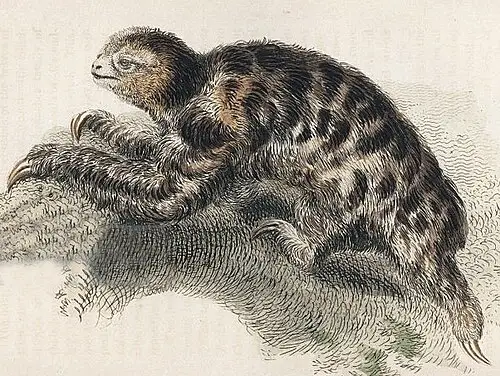
 📸 Photo
Photo: Edward Griffith · Public domain · Wikimedia Commons Source
Pygmy Three-toed Sloth
Bradypus pygmaeus (Pygmy Three-toed Sloth · ヒメミユビナマケモノ)
💡 Everyday Comparisons for Size, Mass & Speed
- 💡 Its maximum weight of 3.5 kg is slightly heavier than a small 3 kg bag of rice (Comparison).
- 💡 Because the single island it inhabits covers only about 5 km², potential habitat damage from rising tourism is a major conservation concern.
Reference standards: coach bus ~12 m, mid-size car ~4.9 m, compact car ~1 t, basketball hoop 3.05 m, credit card 8.56 cm.
Site-computed relative index from recorded values; not a formal scientific metric.
📖 1. Overview
The pygmy three-toed sloth is a sloth that lives only on a single small island off the coast of Panama and was described as a new species in 2001.
🦴 2. Anatomy & Morphology
Its coarse, long gray fur looks greenish because of algae growing on it. It has three large claws on each forefoot and hindfoot, and dark stripes around the eyes.
🔍 3. Ecology & Behavior
It feeds on tree leaves such as red mangrove and spends most of its time in the canopy, though walking on the ground and swimming have also been recorded. Almost nothing is known about its reproduction.
🇰🇷 4. Connection to Korea
No direct record connecting this species to Korea has been found.
📚 Sources & References
- • IUCN Red List CR (2022) — https://www.iucnredlist.org/species/61925/210445926
- • IUCN Red List category CR — latest assessment at iucnredlist.org
- • mammaldiversity.org — 1000429
- • iucnredlist.org — 210445926
- • wikidata.org — Q244121
- • commons.wikimedia.org — File:Bradypus pygmaeus.jpg
- • tb.plazi.org — 03C187E32B15FFC06615F835F588BD3F
- • animaldiversity.org — Bradypus pygmaeus
- • Silhouette: PhyloPic — Sarah Werning · CC BY 3.0 (Congeneric silhouette — Bradypus)
Recorded dimensions are widely cited representative estimates from public literature and may vary by study or specimen.