 📸 Photo
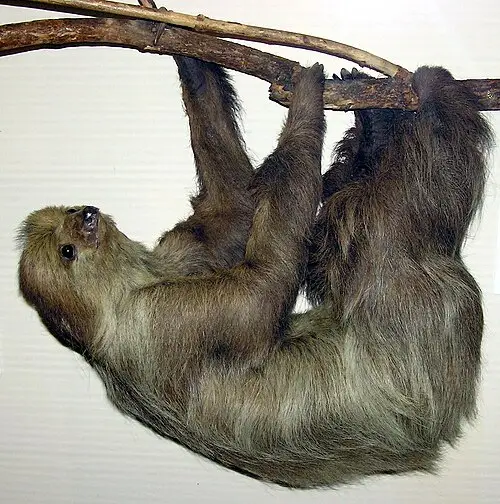
Photo: Arpingstone · Public domain · Wikimedia Commons Source
Linnaeus's Two-toed Sloth
Choloepus didactylus (Linnaeus's Two-toed Sloth · フタユビナマケモノ)
💡 Everyday Comparisons for Size, Mass & Speed
- 💡 In the trees it moves about 125 feet (around 38 m) per day, slightly more than one length of a 25 m swimming pool (Comparison).
- 💡 Described as similar in size and shape to a small dog, its weight of 8 kg is slightly lighter than a 10 kg bag of rice (Comparison).
- 💡 It is also hunted as a prized source of meat.
Reference standards: coach bus ~12 m, mid-size car ~4.9 m, compact car ~1 t, basketball hoop 3.05 m, credit card 8.56 cm.
Site-computed relative index from recorded values; not a formal scientific metric.
📖 1. Overview
Linnaeus's Two-toed Sloth is known as one of the slowest animals, similar in size and shape to a small dog. It spends almost its entire life hanging upside down in trees.
🦴 2. Anatomy & Morphology
It has a short neck with 6 to 7 cervical vertebrae, and four limbs of equal length, each ending in 2 curved claws. Unlike in other mammals, its long grayish-brown fur parts from the belly toward the back, and algae grow in grooves along the hairs, giving it a greenish tint that helps camouflage it.
🔍 3. Ecology & Behavior
It plucks leaves, young shoots, and fruits with its lips, occasionally eats insects, and obtains water from plants and dew. Because of its slow metabolism, it defecates only once a week, and after a gestation of about 6 months it gives birth to a single offspring each year.
🇰🇷 4. Connection to Korea
No direct record connecting this species to Korea has been found.
📚 Sources & References
- • IUCN Red List LC (2022) — https://www.iucnredlist.org/species/4777/210443323
- • IUCN Red List category LC — latest assessment at iucnredlist.org
- • mammaldiversity.org — 1000433
- • iucnredlist.org — 210443323
- • wikidata.org — Q752691
- • commons.wikimedia.org — File:Linnaeuss.two-toed.sloth.arp.jpg
- • animaldiversity.org — Choloepus didactylus
- • Silhouette: PhyloPic — Kai Caspar · CC BY 4.0
Recorded dimensions are widely cited representative estimates from public literature and may vary by study or specimen.