 📸 Photo
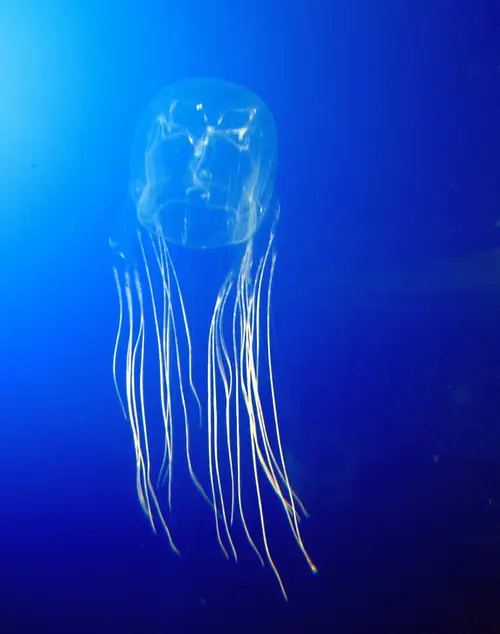
Photo: Avispa marina.jpg : Guido Gautsch , Toyota, Japan derivative work: Mithril ( talk ) · CC BY-SA 2.0 · Wikimedia Commons Source
Australian box jellyfish
Chironex fleckeri (Australian box jellyfish · オーストラリアウンバチクラゲ)
Not Evaluated (NE) on the IUCN Red List yet.
💡 Everyday Comparisons for Size, Mass & Speed
- 💡 Its 3 m tentacles are about 1.5 times the height of a doorway (about 2 m) (Comparison).
- 💡 Known to have caused more than 60 human deaths from stings over the past 100 years, it is the creature swimmers watch out for most along northern Australian beaches (ADW).
Reference standards: coach bus ~12 m, mid-size car ~4.9 m, compact car ~1 t, basketball hoop 3.05 m, credit card 8.56 cm.
Site-computed relative index from recorded values; not a formal scientific metric.
📖 1. Overview
The Australian box jellyfish is a box-bell jellyfish living in northern Australian waters whose sting can be fatal to humans.
🦴 2. Anatomy & Morphology
Its bell is box-shaped and usually 16–24 cm in diameter (rarely 35 cm); up to 15 tentacles at each of the four corners grow up to 3 m long, and it has 24 eyes but no brain.
🔍 3. Ecology & Behavior
It swims actively in shallow water to catch small fish and shrimp with its venomous tentacles, and dies shortly after breeding in rivers in spring, living less than 1 year.
🇰🇷 4. Connection to Korea
No direct record connecting this species to Korea has been found.
📚 Sources & References
- • IUCN Red List: not evaluated (NE) — cross-checked with the Wikidata conservation-status entry
- • marinespecies.org — aphia.php
- • wikidata.org — Q310432
- • commons.wikimedia.org — File:Avispa marina cropped.png
- • animaldiversity.org — Chironex fleckeri
- • Silhouette: PhyloPic — author not recorded · CC0 1.0
Recorded dimensions are widely cited representative estimates from public literature and may vary by study or specimen.