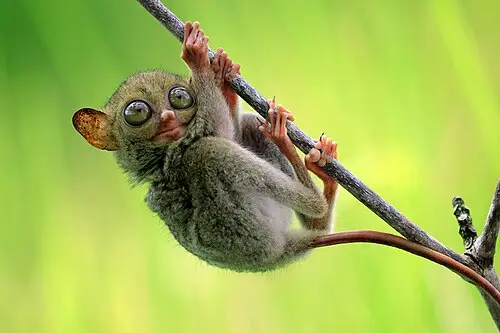
 📸 Photo
Photo: RidhaAnshari85 · CC BY-SA 4.0 · Wikimedia Commons Source
Western Tarsier
Cephalopachus bancanus (Western Tarsier · ニシメガネザル)
💡 Everyday Comparisons for Size, Mass & Speed
- 💡 A male's maximum weight of 134 g is just over two chicken eggs (about 60 g each) (Comparison).
- 💡 A single leap of up to 5.8 m is longer than a passenger car (about 4.5 m) (Comparison).
- 💡 Conversion of forests into oil palm plantations and capture for the illegal pet trade are cited as major threats (ADW).
Reference standards: coach bus ~12 m, mid-size car ~4.9 m, compact car ~1 t, basketball hoop 3.05 m, credit card 8.56 cm.
Site-computed relative index from recorded values; not a formal scientific metric.
📖 1. Overview
The western tarsier is a small nocturnal primate living in the forests of Sumatra and Borneo, with the largest eyes relative to body size of any mammal.
🦴 2. Anatomy & Morphology
Its coat is gray or brown, and its tail—nearly twice its body length—ends in a tuft of hair. Relative to body length, its hind legs are the longest of any mammal, and it can turn its head 180 degrees.
🔍 3. Ecology & Behavior
A purely carnivorous primate, it feeds mainly on insects and also catches small vertebrates such as birds, rodents, and reptiles. Clinging vertically to thin tree stems, it leaps to ambush prey and can cover up to 5.8 m in a single bound.
🇰🇷 4. Connection to Korea
No direct record connecting this species to Korea has been found.
📚 Sources & References
- • IUCN Red List VU (2020) — https://www.iucnredlist.org/species/21488/17976989
- • IUCN Red List category VU — latest assessment at iucnredlist.org
- • mammaldiversity.org — 1000916
- • iucnredlist.org — 17976989
- • wikidata.org — Q22113538
- • commons.wikimedia.org — File:Tarsiu atak Krabuku.jpg
- • animaldiversity.org — Tarsius bancanus
- • Silhouette: PhyloPic — Margot Michaud · CC0 1.0 (Related taxon silhouette — Carlito syrichta)
Recorded dimensions are widely cited representative estimates from public literature and may vary by study or specimen.