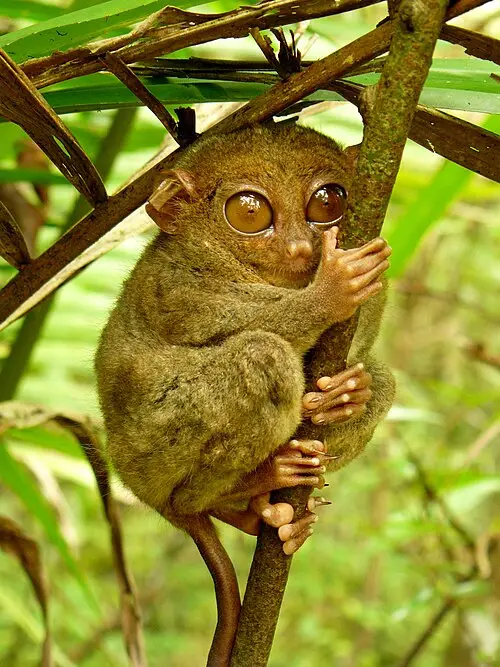
 📸 Photo
Photo: Kok Leng Yeo · CC BY 2.0 · Wikimedia Commons Source
Philippine Tarsier
Carlito syrichta (Philippine Tarsier · フィリピンメガネザル)
💡 Everyday Comparisons for Size, Mass & Speed
- 💡 Being sold as pets and shaken out of trees by hunters are major threats, and captive individuals can pass parasites to their owners.
- 💡 Its maximum weight of 165 g equals about three chicken eggs (Comparison).
- 💡 Its maximum body length of 16 cm is about twice the long side of a credit card (about 8.6 cm) (Comparison).
Reference standards: coach bus ~12 m, mid-size car ~4.9 m, compact car ~1 t, basketball hoop 3.05 m, credit card 8.56 cm.
Site-computed relative index from recorded values; not a formal scientific metric.
📖 1. Overview
The Philippine tarsier is a palm-sized primate with enormous eyes that lives only in island forests of the Philippines.
🦴 2. Anatomy & Morphology
Relative to its body size, its eyes are the largest of any mammal, and it can turn its head 180 degrees. Its tail has a tuft of hair at the tip.
🔍 3. Ecology & Behavior
It catches insects, spiders, lizards, and small birds with both hands and holds them in its mouth to eat. Gestation lasts about 6 months, and females give birth to a single offspring.
🇰🇷 4. Connection to Korea
No direct record connecting this species to Korea has been found.
📚 Sources & References
- • IUCN Red List NT (2020) — https://www.iucnredlist.org/species/21492/17978520
- • IUCN Red List category NT — latest assessment at iucnredlist.org
- • mammaldiversity.org — 1000915
- • iucnredlist.org — 17978520
- • wikidata.org — Q536862
- • commons.wikimedia.org — File:Tarsier Hugs Mossy Branch.jpg
- • animaldiversity.org — Tarsius syrichta
- • Silhouette: PhyloPic — Margot Michaud · CC0 1.0
Recorded dimensions are widely cited representative estimates from public literature and may vary by study or specimen.