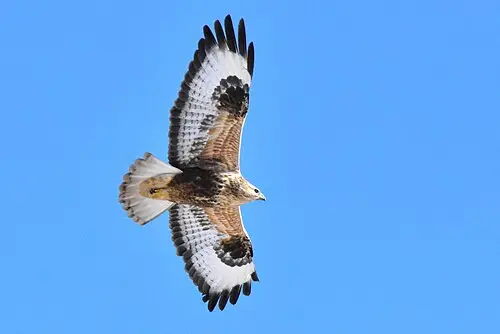
 📸 Photo
Photo: Kudaibergen Amirekul (amirekul) · CC BY-SA 4.0 · Wikimedia Commons Source
Upland Buzzard
Buteo hemilasius (Upland Buzzard · オオノスリ)
🇰🇷 Class II endangered wildlife (Korea)
💡 Everyday Comparisons for Size, Mass & Speed
- 💡 Its mass of 2.05 kg is similar to one 2 L bottle of water (Comparison).
- 💡 In Korea, it can be seen watching for voles across winter fields and reclaimed tidelands.
- 💡 Breeding success depends heavily on vole numbers, so in Mongolia more chicks survive in years when Beuranteu-deuljwi (a Korean animal name for a vole) are abundant.
Reference standards: coach bus ~12 m, mid-size car ~4.9 m, compact car ~1 t, basketball hoop 3.05 m, credit card 8.56 cm.
Site-computed relative index from recorded values; not a formal scientific metric.
📖 1. Overview
The upland buzzard is a large buzzard living in open country from Central Asia and Mongolia to East Asia, and is a rare winter visitor in Korea.
🦴 2. Anatomy & Morphology
Its plumage varies widely from very dark to pale, and it has a long barred tail and partially feathered legs. In flight, it holds its wings in a V shape.
🔍 3. Ecology & Behavior
It mainly eats rodents such as voles, ground squirrels, and gerbils, and also catches frogs, beetles, and larks. It builds a small stick nest on rock cliffs or stone piles and lays 2–4 eggs, incubating them for 35–38 days.
🇰🇷 4. Connection to Korea
In Korea, it is a Class II endangered wildlife (Korea) species and a rare winter visitor seen in farmlands, plains, and reclaimed land.
📚 Sources & References
- • IUCN Red List LC (2021) — https://www.iucnredlist.org/species/22695967/202604414
- • 멸종위기 야생생물 Ⅱ급 — 국가생물종목록(국립생물자원관) ktsn 120000001610 — https://species.nibr.go.kr/home/mainHome.do?cont_link=009&subMenu=009002&contCd=009002&ktsn=120000001610
- • IUCN Red List category LC — latest assessment at iucnredlist.org
- • Korean protection status: Class II endangered wildlife (Korea)
- • doi.org — avilist.v2026
- • iucnredlist.org — 202604414
- • 국가생물종목록(국립생물자원관) ktsn 120000001610 — https://species.nibr.go.kr/home/mainHome.do?cont_link=009&subMenu=009002&contCd=009002&ktsn=120000001610
- • wikidata.org — Q852194
- • commons.wikimedia.org — File:Buteo hemilasius from iNaturalist photo 252919535.jpg
- • peregrinefund.org — upland-buzzard
- • nie.re.kr — enspc06003v.do
- • Silhouette: PhyloPic — Shyamal · CC BY 3.0 (Congeneric silhouette — Buteo)
Recorded dimensions are widely cited representative estimates from public literature and may vary by study or specimen.