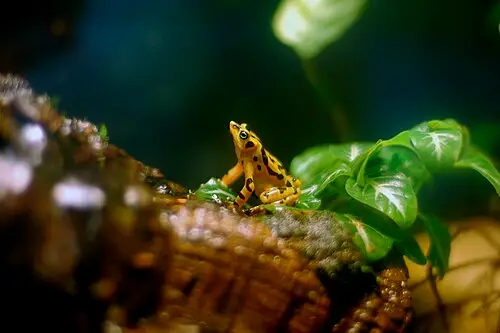
 📸 Photo
Photo: Jeff Kubina from the milky way galaxy · CC BY-SA 2.0 · Wikimedia Commons Source
Panamanian Golden Frog
Atelopus zeteki (Panamanian Golden Frog · Panamanian Golden Frog)
💡 Everyday Comparisons for Size, Mass & Speed
- 💡 A maximum female length of 6.3 cm is similar to 2.4 Korean 500-won coins (26.5 mm diameter) lined up, and a maximum weight of 15 g is about two 500-won coins (7.7 g each) (Comparison).
- 💡 The Smithsonian's National Zoo notes that adults at the zoo are fed mainly fruit flies, bean beetles, and crickets (Smithsonian's National Zoo).
Reference standards: coach bus ~12 m, mid-size car ~4.9 m, compact car ~1 t, basketball hoop 3.05 m, credit card 8.56 cm.
Site-computed relative index from recorded values; not a formal scientific metric.
📖 1. Overview
The Panamanian Golden Frog is a small, brightly colored yellow animal living along forest streams in west-central Panama; although frog-like in appearance, it belongs to the toad family. The IUCN assesses it as Critically Endangered (CR, 2019).
🦴 2. Anatomy & Morphology
Its head is longer than wide with a pointed snout, a slender body, and long legs. The smooth yellow back bears 'X'-shaped or irregular black blotches, and the skin of wild individuals contains tetrodotoxin and zetekitoxin potent enough that a single frog carries enough toxin to kill 1,200 mice.
🔍 3. Ecology & Behavior
It hunts by day using its eyesight, feeding mainly on insects and small invertebrates, while young froglets eat springtails. Individuals from wet forests are larger than those from dry forests.
🇰🇷 4. Connection to Korea
No direct record connecting this species to Korea has been found.
📚 Sources & References
- • IUCN Red List CR (2019) — https://www.iucnredlist.org/species/54563/54341110
- • IUCN Red List category CR — latest assessment at iucnredlist.org
- • catalogueoflife.org — 5VVKC
- • iucnredlist.org — 54341110
- • wikidata.org — Q2048914
- • commons.wikimedia.org — File:Atelopus zeteki.jpg
- • nationalzoo.si.edu — panamanian-golden-frog
- • bok.or.kr — contents.do
- • Silhouette: PhyloPic — Vijay Karthick · CC0 1.0 (Related taxon silhouette — Pedostibes tuberculosus)
Recorded dimensions are widely cited representative estimates from public literature and may vary by study or specimen.