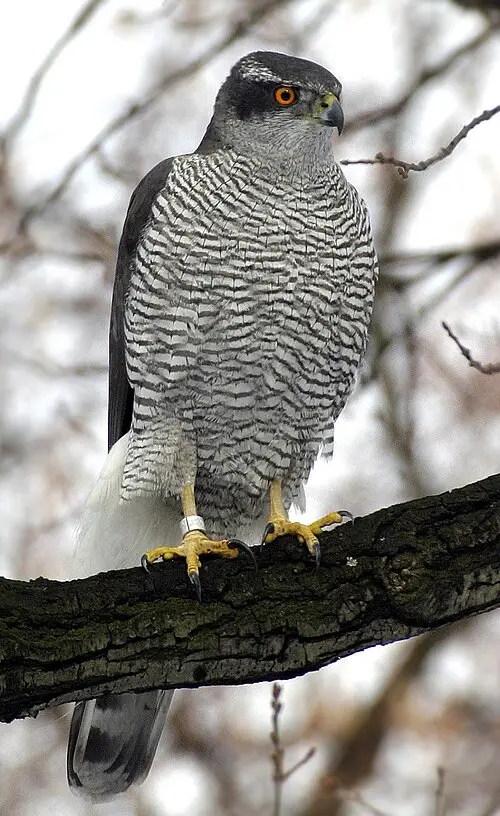
 📸 Photo
Photo: Norbert Kenntner, Berlin · CC BY-SA 3.0 · Wikimedia Commons Source
Eurasian Goshawk
Astur gentilis (Eurasian Goshawk · オオタカ)
Not Evaluated (NE) on the IUCN Red List yet.
🇰🇷 Class II endangered wildlife (Korea) · Natural Monument (Korea) «Eurasian Goshawk»
💡 Everyday Comparisons for Size, Mass & Speed
- 💡 It has long been prized for falconry.
- 💡 Its weight of 1.364 kg is lighter than a 1.5 L bottle of water.
- 💡 In Europe, it has begun to colonize urban areas as well.
Reference standards: coach bus ~12 m, mid-size car ~4.9 m, compact car ~1 t, basketball hoop 3.05 m, credit card 8.56 cm.
Site-computed relative index from recorded values; not a formal scientific metric.
📖 1. Overview
The Eurasian Goshawk is a medium-sized raptor of Northern Hemisphere coniferous and deciduous forests that swiftly hunts birds and mammals. Its former scientific name is Accipiter gentilis.
🦴 2. Anatomy & Morphology
Adults have a broad white supercilium above reddish-brown eyes, slate-grey to blackish upperparts, and white underparts barred with grey. Juveniles have yellow eyes and brown vertical streaks below, and females are larger than males.
🔍 3. Ecology & Behavior
It preys mainly on mammals such as squirrels and hares and birds such as grouse, ambushing from cover or flying low along forest edges. It lays 2–4 eggs from early April to mid-June (months 4–6).
🇰🇷 4. Connection to Korea
In Korea, it is designated as Class II Endangered Wildlife and was named a Natural Monument on November 16, 1982.
📚 Sources & References
- • 멸종위기 야생생물 Ⅱ급 · 천연기념물 «참매» — 국가생물종목록(국립생물자원관) ktsn 120000001605 — https://species.nibr.go.kr/home/mainHome.do?cont_link=009&subMenu=009002&contCd=009002&ktsn=120000001605
- • IUCN Red List: not evaluated (NE) — cross-checked with the Wikidata conservation-status entry
- • Korean protection status: Class II endangered wildlife (Korea) · Natural Monument (Korea) «Eurasian Goshawk»
- • doi.org — avilist.v2026
- • 국가생물종목록(국립생물자원관) ktsn 120000001605 — https://species.nibr.go.kr/home/mainHome.do?cont_link=009&subMenu=009002&contCd=009002&ktsn=120000001605
- • heritage.go.kr — culSelectDetail.do
- • wikidata.org — Q137474876
- • commons.wikimedia.org — File:Northern Goshawk ad M2.jpg
- • nie.re.kr — view.do
- • animaldiversity.org — Accipiter gentilis
- • peregrinefund.org — northern-goshawk
- • Silhouette: PhyloPic — Robert Cooke · CC0 1.0 (Related taxon silhouette — Accipitridae)
Recorded dimensions are widely cited representative estimates from public literature and may vary by study or specimen.