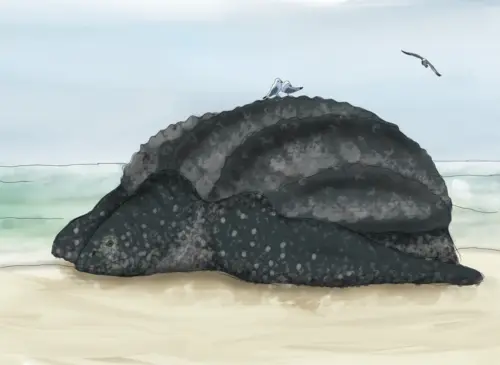
 🎨 Restoration
Restoration: PaleoEquii · CC BY-SA 4.0 · Wikimedia Commons Source
Life restorations are artistic reconstructions based on fossil evidence; true coloration and soft-tissue details remain uncertain.
Archelon
Archelon ischyros (Archelon · Archelon)
Known only from fossils. The IUCN Red List assesses only species extant since 1500 CE, so fossil taxa are not assigned a category.
💡 Everyday Comparisons for Size, Mass & Speed
- 💡 Its body length of 4.6 m is similar to the length of a midsize passenger car (about 4.5 m) (Comparison).
- 💡 The largest living turtle, the leatherback sea turtle, reaches up to 2.7 m, which is about 59% the size of the 4.6 m Archelon ischyros (calculated from Natural History Museum, London figures).
Reference standards: coach bus ~12 m, mid-size car ~4.9 m, compact car ~1 t, basketball hoop 3.05 m, credit card 8.56 cm.
Site-computed relative index from recorded values; not a formal scientific metric.
📖 1. Overview
Archelon ischyros is the largest turtle known so far, having lived in Late Cretaceous seas. The Natural History Museum, London explains that it lived about 80–74 million years ago.
🦴 2. Anatomy & Morphology
Its shell was closer to a skeletal framework than a solidly fused plate, and it had nasal bones above the nostrils. Its hooked beak suggests a powerful bite, and the largest specimen had a flipper span of about 4 m.
🔍 3. Fossil Record & Paleoecology
Because no fossilized stomach contents have been found, its exact diet is uncertain, though skull shape and data from relatives suggest it ate mollusks and perhaps fish, seaweed, and jellyfish. It shared the sea with predators such as mosasaurs and likely laid eggs on beaches like modern sea turtles.
🇰🇷 4. Connection to Korea
No direct record connecting this species to Korea has been found.
📚 Sources & References
- • Fossil taxon — the IUCN Red List assesses only species living or extinct since 1500
- • paleobiodb.org — basicTaxonInfo
- • wikidata.org — Q20717056
- • commons.wikimedia.org — File:Big fossil turtle.jpg
- • nhm.ac.uk — giant-prehistoric-turtles.html
- • Silhouette: PhyloPic — author not recorded · CC0 1.0
Recorded dimensions are widely cited representative estimates from public literature and may vary by study or specimen.