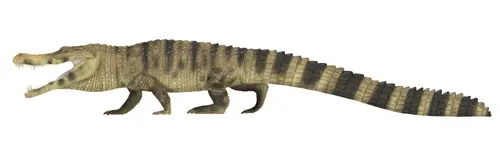
 🎨 Restoration
Restoration: Sphenaphinae · CC BY-SA 4.0 · Wikimedia Commons Source
Life restorations are artistic reconstructions based on fossil evidence; true coloration and soft-tissue details remain uncertain.
Deinosuchus
Deinosuchus riograndensis (Deinosuchus · Deinosuchus)
Known only from fossils. The IUCN Red List assesses only species extant since 1500 CE, so fossil taxa are not assigned a category.
💡 Everyday Comparisons for Size, Mass & Speed
- 💡 An estimated body length of 7.66 m is about the length of 1.7 mid-size passenger cars (about 4.5 m each) placed end to end (Comparison).
- 💡 Tooth marks left on dinosaur bones serve as evidence that this crocodilian also targeted large dinosaurs.
Reference standards: coach bus ~12 m, mid-size car ~4.9 m, compact car ~1 t, basketball hoop 3.05 m, credit card 8.56 cm.
📖 1. Overview
Deinosuchus riograndensis (genus Deinosuchus) belonged to a group of giant crocodilians that lived along the coasts of North America during the Late Cretaceous and is counted among the largest crocodylians. A 2025 study considers it not closely related to modern crocodiles or alligators.
🦴 2. Anatomy & Morphology
Because its snout was relatively long, older methods that estimated body length from short-snouted living crocodilians may have overstated its length. Therefore, the 2025 study re-estimated its body length using head width.
🔍 3. Fossil Record & Paleoecology
Bite marks found on large dinosaur bones and coastal sea turtle bones indicate that it hunted large prey. Tooth enamel analysis of eastern specimens suggests that it may have drunk seawater or eaten marine prey.
🇰🇷 4. Connection to Korea
No direct record connecting this species to Korea has been found.
📚 Sources & References
- • Fossil taxon — the IUCN Red List assesses only species living or extinct since 1500
- • paleobiodb.org — basicTaxonInfo
- • wikidata.org — Q133855094
- • commons.wikimedia.org — File:Deinosuchus riograndensis.png
- • pmc.ncbi.nlm.nih.gov — PMC12018936
Recorded dimensions are widely cited representative estimates from public literature and may vary by study or specimen.