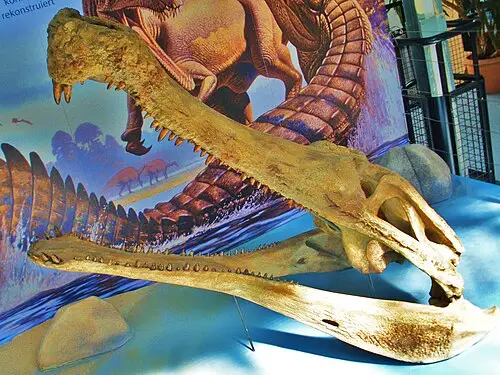
 🎨 Restoration
Restoration: Ghedoghedo · CC BY-SA 3.0 · Wikimedia Commons Source
Life restorations are artistic reconstructions based on fossil evidence; true coloration and soft-tissue details remain uncertain.
Sarcosuchus
Sarcosuchus imperator (Sarcosuchus · Sarcosuchus)
Known only from fossils. The IUCN Red List assesses only species extant since 1500 CE, so fossil taxa are not assigned a category.
💡 Everyday Comparisons for Size, Mass & Speed
- 💡 Its estimated body length of about 12 m at the time of publication is roughly the length of a large bus (Comparison).
- 💡 Its skull length of about 1.8 m is similar to the height of a tall adult human (Comparison). The University of Chicago noted that a cast of the skull was placed on display in its library.
Reference standards: coach bus ~12 m, mid-size car ~4.9 m, compact car ~1 t, basketball hoop 3.05 m, credit card 8.56 cm.
Site-computed relative index from recorded values; not a formal scientific metric.
📖 1. Overview
Sarcosuchus imperator ('SuperCroc') was a giant crocodyliform reptile that lived in Africa during the Early Cretaceous. It became widely known after being published in the journal Science in 2001.
🦴 2. Anatomy & Morphology
The skull of a full-grown adult reached about 6 feet (about 1.8 m) in length, whereas juveniles measured 3–4 feet.
🔍 3. Fossil Record & Paleoecology
It was reported to have preyed on dinosaurs as well as fish about 12 feet (about 3.7 m) long. Growth lines in its bones indicate that it took about 42 years to reach full adult size and that large adults lived for at least 50 years or more.
🇰🇷 4. Connection to Korea
No direct record connecting this species to Korea has been found.
📚 Sources & References
- • Fossil taxon — the IUCN Red List assesses only species living or extinct since 1500
- • paleobiodb.org — basicTaxonInfo
- • wikidata.org — Q137865425
- • commons.wikimedia.org — File:Museum of Natural History Sarcosuchus.jpg
- • chronicle.uchicago.edu — supercroc.shtml
- • sciencedaily.com — 011101060724.htm
- • Silhouette: PhyloPic — Miguel Hernández · CC0 1.0
Recorded dimensions are widely cited representative estimates from public literature and may vary by study or specimen.