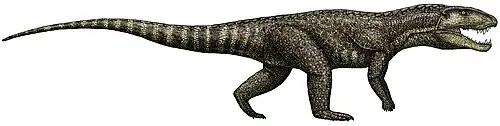
 🎨 Restoration
Restoration: Petrified Forest from Petrified Forest, USA · Public domain · Wikimedia Commons Source
Life restorations are artistic reconstructions based on fossil evidence; true coloration and soft-tissue details remain uncertain.
Postosuchus
Postosuchus kirkpatricki (Postosuchus · Postosuchus)
Known only from fossils. The IUCN Red List assesses only species extant since 1500 CE, so fossil taxa are not assigned a category.
💡 Everyday Comparisons for Size, Mass & Speed
- 💡 The genus name comes from the town of Post, Texas, where its fossils were found.
- 💡 The UC Museum of Paleontology notes that the largest rauisuchians reached up to 6 m in length—about one and 1/3 mid-sized passenger cars (about 4.5 m) (Comparison; not a measurement specific to this species alone).
Reference standards: coach bus ~12 m, mid-size car ~4.9 m, compact car ~1 t, basketball hoop 3.05 m, credit card 8.56 cm.
📖 1. Overview
Postosuchus kirkpatricki (genus Postosuchus) was a rauisuchian that lived in North America during the Late Triassic; although it looked like a carnivorous dinosaur, it actually belonged to a group closely related to crocodilians. It is introduced as the top predator in Texas during its time.
🦴 2. Anatomy & Morphology
The University of California Museum of Paleontology (UCMP) explains that rauisuchians, the group containing Postosuchus, had a large head, sharp teeth, long hind legs, and armored scales along the back. The holotype preserves about 75% of the skeleton in a disarticulated state.
🔍 3. Fossil Record & Paleoecology
The holotype came from the Post Quarry (Cooper Canyon Formation) in Garza County, Texas, and the US National Park Service notes that this species is also found in Petrified Forest National Park in Arizona. Members of this group were large carnivorous hunters of the Late Triassic.
🇰🇷 4. Connection to Korea
No direct record connecting this species to Korea has been found.
📚 Sources & References
- • Fossil taxon — the IUCN Red List assesses only species living or extinct since 1500
- • paleobiodb.org — basicTaxonInfo
- • wikidata.org — Q20719092
- • commons.wikimedia.org — File:Postosuchus kirkpatricki flipped.jpg
- • ucmp.berkeley.edu — rauisuchia.php
- • depts.ttu.edu — dino-changing-world-gallery-guide.pdf
- • nps.gov — Museum Detectives Lesson Plan 2016.pdf
- • nps.gov — pseudosuchians.htm
- • journalpub.escholarship.org — download
- • Silhouette: PhyloPic — Dr. Jeff Martz/National Park Service · Public Domain Mark 1.0
Recorded dimensions are widely cited representative estimates from public literature and may vary by study or specimen.