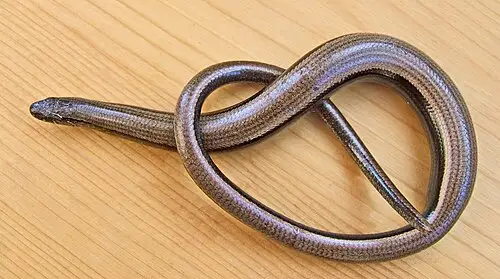
 📸 Photo
Photo: Wildfeuer · CC BY-SA 3.0 · Wikimedia Commons Source
Slow Worm
Anguis fragilis (Slow Worm · ヒメアシナシトカゲ)
💡 Everyday Comparisons for Size, Mass & Speed
- 💡 Its snout-to-vent length of 20 cm is similar to the short side of an A4 sheet of paper (21 cm), and its weight of 100 g is about the weight of two chicken eggs (Comparison).
- 💡 In Britain it is commonly encountered in suburban gardens and is helpful because it eats slugs, a common garden pest (University of Michigan Museum of Zoology ADW).
Reference standards: coach bus ~12 m, mid-size car ~4.9 m, compact car ~1 t, basketball hoop 3.05 m, credit card 8.56 cm.
Site-computed relative index from recorded values; not a formal scientific metric.
📖 1. Overview
The Slow Worm is a smooth, legless lizard that looks like a snake and spends most of its time underground or beneath stones.
🦴 2. Anatomy & Morphology
Its smooth, elongated body lacks legs. Adults are grayish-brown to copper-colored, while juveniles are pale gold or silver with dark sides. Females have dark stripes along the back and flanks, whereas males lack stripes and some males have blue spots.
🔍 3. Ecology & Behavior
It feeds mainly on slugs and earthworms. In Britain, it overwinters underground from October to March, mates in April–May, and gives birth in August–September to live young that hatch inside the mother's body, with females usually breeding every other year.
🇰🇷 4. Connection to Korea
No direct record connecting this species to Korea has been found.
📚 Sources & References
- • IUCN Red List LC (2024) — https://www.iucnredlist.org/species/47113126/204902180
- • IUCN Red List category LC — latest assessment at iucnredlist.org
- • catalogueoflife.org — 672H4
- • iucnredlist.org — 204902180
- • wikidata.org — Q183660
- • animaldiversity.org — Anguis fragilis
- • Silhouette: PhyloPic — Steven Traver · CC0 1.0
Recorded dimensions are widely cited representative estimates from public literature and may vary by study or specimen.