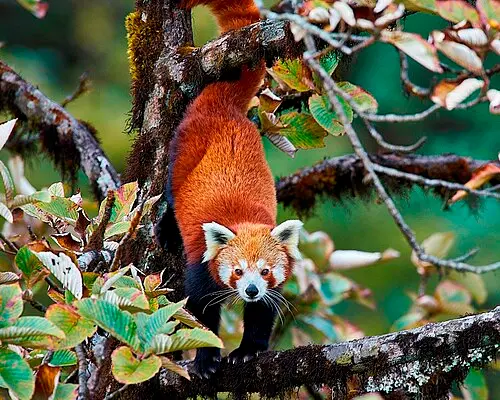
 📸 Photo
Photo: Ajit Hota · CC BY-SA 4.0 · Wikimedia Commons Source
Western Red Panda
Ailurus fulgens (Western Red Panda · レッサーパンダ)
💡 Everyday Comparisons for Size, Mass & Speed
- 💡 Its head-and-body length of 62.5 cm is about 2.1 times the long side of an A4 sheet of paper (29.7 cm) (Comparison).
- 💡 A weight of 6.2 kg equals three 2-liter bottles of water (Comparison).
- 💡 It is the state animal of Sikkim, India, and the mascot of the Darjeeling International Tea Festival (ADW).
Reference standards: coach bus ~12 m, mid-size car ~4.9 m, compact car ~1 t, basketball hoop 3.05 m, credit card 8.56 cm.
Site-computed relative index from recorded values; not a formal scientific metric.
📖 1. Overview
The western red panda is a reddish-brown animal living in bamboo-rich temperate mountain forests of the Himalayas, feeding mainly on bamboo leaves and spending much of its time in trees.
🦴 2. Anatomy & Morphology
Its white face has reddish-brown tear marks beneath the eyes, while the back is reddish brown and the belly and legs are glossy black. Its tail is marked with about 12 alternating red and buff rings, though it is not prehensile.
🔍 3. Ecology & Behavior
A solitary animal, it is most active at dusk, dawn, and night, nesting in conifers. It bends bamboo down to grasp with a forepaw and chews leaves inserted into the side of its mouth, and also eats berries, flowers, and bird eggs. Most young are born in June after a gestation of about 134 days.
🇰🇷 4. Connection to Korea
No direct record connecting this species to Korea has been found.
📚 Sources & References
- • IUCN Red List EN (2015) — https://www.iucnredlist.org/species/714/110023718
- • IUCN Red List category EN — latest assessment at iucnredlist.org
- • mammaldiversity.org — 1005802
- • iucnredlist.org — 110023718
- • wikidata.org — Q41960
- • commons.wikimedia.org — File:RedPanda SingalilaNationalPark DFrame.jpg
- • animaldiversity.org — Ailurus fulgens
- • Silhouette: PhyloPic — Xavier A. Jenkins · CC0 1.0
Recorded dimensions are widely cited representative estimates from public literature and may vary by study or specimen.