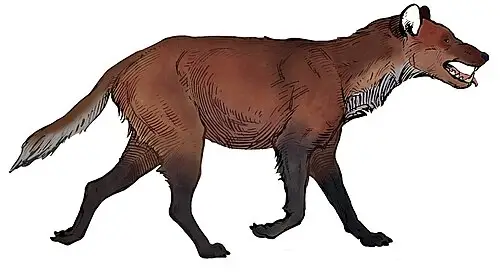
 🎨 Restoration
Restoration: Mariomassone , based on an original by Erwin S. Christman · Public domain · Wikimedia Commons Source
Life restorations are artistic reconstructions based on fossil evidence; true coloration and soft-tissue details remain uncertain.
Aenocyon
Aenocyon dirus (Aenocyon · ダイアウルフ)
Known only from fossils. The IUCN Red List assesses only species extant since 1500 CE, so fossil taxa are not assigned a category.
💡 Everyday Comparisons for Size, Mass & Speed
- 💡 Its maximum body weight of 68 kg is similar to the weight of an adult man (Comparison). It is familiar to the public as the wolf featured in the drama 'Game of Thrones' (La Brea Tar Pits description).
- 💡 Although there was a recent announcement claiming that the dire wolf had been brought back to life, researchers at the La Brea Tar Pits explain that extinct species cannot be revived.
Reference standards: coach bus ~12 m, mid-size car ~4.9 m, compact car ~1 t, basketball hoop 3.05 m, credit card 8.56 cm.
Site-computed relative index from recorded values; not a formal scientific metric.
📖 1. Overview
Aenocyon dirus (the dire wolf) is a large wolf-like canid that lived in North America from about 250,000 to about 10,000 years ago. Following a 2021 genetic study, it was moved to a separate genus (Aenocyon) not closely related to the gray wolf.
🦴 2. Anatomy & Morphology
Although similar in outward appearance to the gray wolf, it had a stockier, more muscular build and was about 25% heavier at 130–150 pounds.
🔍 3. Fossil Record & Paleoecology
It was the largest Late Pleistocene canid in North America, and its fossils are found in large numbers at the La Brea Tar Pits. Recent genetic analysis showed that it belonged to a North American lineage that diverged from the gray wolf lineage about 6 million years ago.
🇰🇷 4. Connection to Korea
No direct record connecting this species to Korea has been found.
📚 Sources & References
- • Fossil taxon — the IUCN Red List assesses only species living or extinct since 1500
- • paleobiodb.org — basicTaxonInfo
- • wikidata.org — Q496689
- • commons.wikimedia.org — File:Canis dirus Skeleton.jpg
- • nps.gov — dire-wolves.htm
- • nps.gov — dire-wolf.htm
- • tarpits.org — our-evolving-understanding-dire-wolves
- • nature.com — s41586-020-03082-x
- • Silhouette: PhyloPic — Margot Michaud · CC0 1.0
Recorded dimensions are widely cited representative estimates from public literature and may vary by study or specimen.