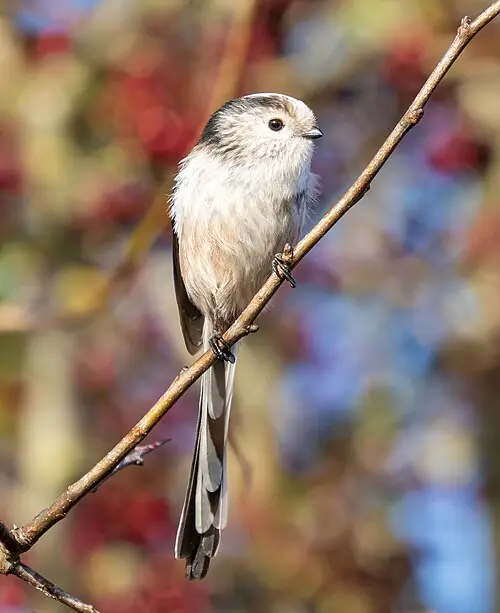
 📸 Photo
Photo: Rhododendrites · CC BY-SA 4.0 · Wikimedia Commons Source
Long-tailed Tit
Aegithalos caudatus (Long-tailed Tit · エナガ)
💡 Everyday Comparisons for Size, Mass & Speed
- 💡 Its weight of about 9 g is slightly heavier than one Korean 500-won coin (7.7 g) (Comparison).
- 💡 Its body length of 14 cm is similar to the length of one ballpoint pen (Comparison).
- 💡 In autumn and winter, it is increasingly seen visiting seed feeders (ADW).
Reference standards: coach bus ~12 m, mid-size car ~4.9 m, compact car ~1 t, basketball hoop 3.05 m, credit card 8.56 cm.
Site-computed relative index from recorded values; not a formal scientific metric.
📖 1. Overview
The Long-tailed Tit is a round little bird with a tail longer than its body and is a common resident breeding throughout the forests of Korea.
🦴 2. Anatomy & Morphology
Its body is round, its bill is tiny and triangular, and its tail is as long as its body. Its forehead, crown, nape, and chin are white, and a thick black eyebrow stripe above the eye reaches the back of the neck.
🔍 3. Ecology & Behavior
It gleans small insects and spiders from branches and leaves, and also eats plant seeds in autumn and winter. In winter, flocks huddle together to sleep and conserve body heat, and it builds a ball-shaped nest of moss, hair, and spiderwebs to lay 7–11 eggs.
🇰🇷 4. Connection to Korea
According to the National List of Species of Korea, it is a common resident bird that breeds in forests throughout the Korean Peninsula.
📚 Sources & References
- • IUCN Red List LC (2024) — https://www.iucnredlist.org/species/103871923/264587236
- • IUCN Red List category LC — latest assessment at iucnredlist.org
- • doi.org — avilist.v2026
- • iucnredlist.org — 264587236
- • 국가생물종목록(국립생물자원관) ktsn 120000001998 — https://species.nibr.go.kr/home/mainHome.do?cont_link=009&subMenu=009002&contCd=009002&ktsn=120000001998
- • wikidata.org — Q170831
- • commons.wikimedia.org — File:Long-tailed tit (74940).jpg
- • animaldiversity.org — Aegithalos caudatus
- • species.nibr.go.kr — mainHome.do
- • Silhouette: PhyloPic — Matt Wilkins (photo by Andreas Trepte, www.photo-natur.net) · CC BY 3.0
Recorded dimensions are widely cited representative estimates from public literature and may vary by study or specimen.