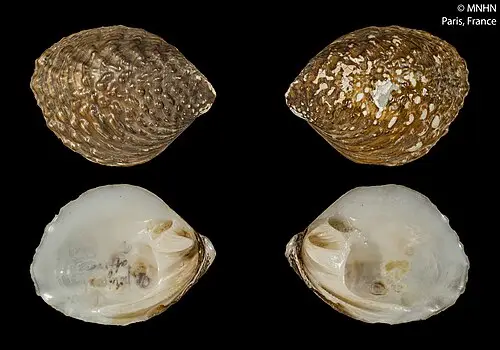
 📸 Photo
Photo: Manuel CABALLER · CC BY 4.0 · Wikimedia Commons Source
Aculamprotula polysticta
Aculamprotula polysticta (Aculamprotula polysticta · Aculamprotula polysticta)
Not Evaluated (NE) on the IUCN Red List yet.
🇰🇷 Class I endangered wildlife (Korea)
💡 Everyday Comparisons for Size, Mass & Speed
- 💡 An adult length of 9.1 cm is slightly longer than the long side of a credit card (about 8.6 cm) (Comparison).
- 💡 It is an endangered freshwater mussel confirmed to live only in certain sections of the Geum River and Seomjin River (National Institute of Ecology).
Reference standards: coach bus ~12 m, mid-size car ~4.9 m, compact car ~1 t, basketball hoop 3.05 m, credit card 8.56 cm.
📖 1. Overview
Aculamprotula polysticta is a freshwater mussel living only in Korean rivers and protected as Class I endangered wildlife (Korea).
🦴 2. Anatomy & Morphology
A medium-to-large species among Korean freshwater mussels, its shell is rounded-ovate, thick, and solid. Numerous coarse tubercles cover the upper part of the shell; the exterior is greenish-brown over a yellow ground, and the interior has a pearly luster.
🔍 3. Ecology & Behavior
Adults filter-feed on organic matter and plankton. Around October, brood pouches form in the female's gills and release glochidia larvae the following April; the larvae attach to fish with hooks as parasites before transforming into juvenile mussels.
🇰🇷 4. Connection to Korea
It is designated as Class I endangered wildlife (Korea) and is endemic to Korea. The Han River population has had no observation records since 1987 and is presumed extirpated, while populations are confirmed in parts of the Geum River and Seomjin River. Overharvesting, rapid flow changes, and declines in host fish are major threats.
📚 Sources & References
- • 멸종위기 야생생물 Ⅰ급 — 국가생물종목록(국립생물자원관) ktsn 120000471810 — https://species.nibr.go.kr/home/mainHome.do?cont_link=009&subMenu=009002&contCd=009002&ktsn=120000471810
- • IUCN Red List: not evaluated (NE) — cross-checked with the Wikidata conservation-status entry
- • Korean protection status: Class I endangered wildlife (Korea)
- • catalogueoflife.org — 7PTPL
- • 국가생물종목록(국립생물자원관) ktsn 120000471810 — https://species.nibr.go.kr/home/mainHome.do?cont_link=009&subMenu=009002&contCd=009002&ktsn=120000471810
- • wikidata.org — Q107336513
- • nie.re.kr — view.do
Recorded dimensions are widely cited representative estimates from public literature and may vary by study or specimen.