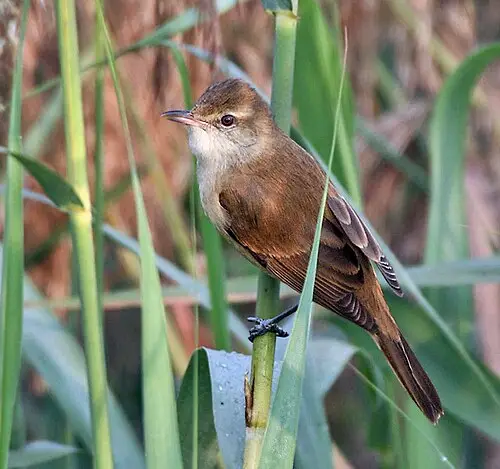
 📸 Photo
Photo: J.M.Garg · CC BY-SA 3.0 · Wikimedia Commons Source
Oriental Reed Warbler
Acrocephalus orientalis (Oriental Reed Warbler · オオヨシキリ)
💡 Everyday Comparisons for Size, Mass & Speed
- 💡 The bird that climbs to the tips of reeds and sings loudly in riverside or lakeside reedbeds in summer is the Oriental Reed Warbler (National List of Species of Korea).
- 💡 It builds its nest by weaving reed and cattail stems together (National List of Species of Korea).
Reference standards: coach bus ~12 m, mid-size car ~4.9 m, compact car ~1 t, basketball hoop 3.05 m, credit card 8.56 cm.
📖 1. Overview
The Oriental Reed Warbler is a summer visitor that sings loudly in reedbeds along the edges of wetlands and breeds throughout Korea.
🦴 2. Anatomy & Morphology
It is uniformly pale brown overall with a paler underside and a nearly white belly. It has a white supercilium, and males and females are hard to tell apart by color.
🔍 3. Ecology & Behavior
It lives mainly among reeds and grasses, climbing to the top of a reed to sing loudly. It weaves reed or cattail stems together to build its nest, and because several birds occupy the same site, many males can be heard singing at peak times.
🇰🇷 4. Connection to Korea
According to the National List of Species of Korea, its domestic distribution is nationwide, and it is a summer visitor living in reeds and grasses along wetland edges.
📚 Sources & References
- • IUCN Red List LC (2024) — https://www.iucnredlist.org/species/22734033/263772103
- • IUCN Red List category LC — latest assessment at iucnredlist.org
- • doi.org — avilist.v2026
- • iucnredlist.org — 263772103
- • 국가생물종목록(국립생물자원관) ktsn 120000155413 — https://species.nibr.go.kr/home/mainHome.do?cont_link=009&subMenu=009002&contCd=009002&ktsn=120000155413
- • wikidata.org — Q73456
- • commons.wikimedia.org — File:Oriental Reed Warbler (Acrocephalus orientalis) in Kolk
- • species.nibr.go.kr — mainHome.do
- • Silhouette: PhyloPic — Roger Culos · CC BY 4.0 (Congeneric silhouette — Acrocephalus scirpaceus)
Recorded dimensions are widely cited representative estimates from public literature and may vary by study or specimen.