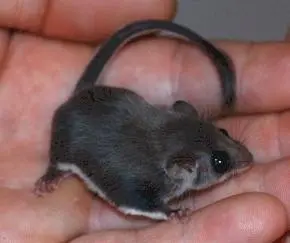
 📸 Photo
Photo: Acrobates_pygmaeus_1.jpg : Doug Beckers from Killcare Heights, Australia derivative work: Berichard ( talk ) · CC BY-SA 2.0 · Wikimedia Commons Source
Narrow-toed Feather-tailed Glider
Acrobates pygmaeus (Narrow-toed Feather-tailed Glider · チビフクロモモンガ)
💡 Everyday Comparisons for Size, Mass & Speed
- 💡 Its average weight of 13 g is slightly lighter than two Korean 500-won coins (about 15.4 g) (Comparison).
- 💡 It has been recorded nesting in groups inside almost any enclosed space, including not only hollow trees but also telephone switch boxes, bird nests, and possum dreys.
Reference standards: coach bus ~12 m, mid-size car ~4.9 m, compact car ~1 t, basketball hoop 3.05 m, credit card 8.56 cm.
Site-computed relative index from recorded values; not a formal scientific metric.
📖 1. Overview
The narrow-toed feather-tailed glider is a tiny gliding marsupial native to Australia, best known for its feather-like tail.
🦴 2. Anatomy & Morphology
It possesses a feather-shaped tail unseen in any other mammal. Its large, forward-facing eyes provide binocular vision at night, and each toe has a large serrated pad that allows it to cling even to smooth surfaces.
🔍 3. Ecology & Behavior
It spends most of its feeding time in eucalyptus trees, searching under bark or gleaning leaves for honeydew, manna, and arthropods. Active at night, it builds spherical nests from grass and leaves, and groups of up to 20 individuals have been recorded together at one time.
🇰🇷 4. Connection to Korea
No direct record connecting this species to Korea has been found.
📚 Sources & References
- • IUCN Red List LC (2016) — https://www.iucnredlist.org/species/40584/21963834
- • IUCN Red List category LC — latest assessment at iucnredlist.org
- • mammaldiversity.org — 1000332
- • iucnredlist.org — 21963834
- • wikidata.org — Q613177
- • commons.wikimedia.org — File:Acrobates pygmaeus 2.jpg
- • animaldiversity.org — Acrobates pygmaeus
- • Silhouette: PhyloPic — Sarah Werning · CC BY 3.0
Recorded dimensions are widely cited representative estimates from public literature and may vary by study or specimen.