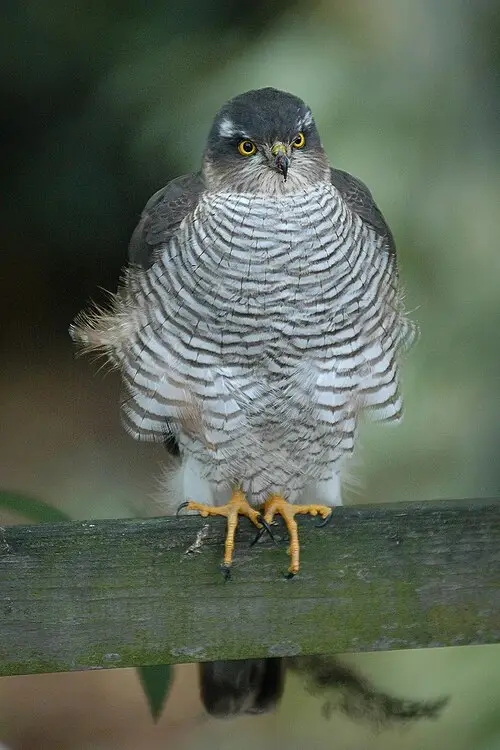
 📸 Photo
Photo: Meneer Zjeroen · CC BY 2.0 · Wikimedia Commons Source
Eurasian Sparrowhawk
Accipiter nisus (Eurasian Sparrowhawk · ハイタカ)
🇰🇷 Class II endangered wildlife (Korea) · Natural Monument (Korea) «Eurasian Sparrowhawk»
💡 Everyday Comparisons for Size, Mass & Speed
- 💡 Its body length of 0.40 m is slightly longer than the long side of a sheet of A4 paper (29.7 cm) (Comparison).
- 💡 Its weight of 0.342 kg is close to the weight of 6 eggs (taking 1 egg as 60 g, Comparison).
- 💡 It also hunts near human settlements such as parks and farmland.
Reference standards: coach bus ~12 m, mid-size car ~4.9 m, compact car ~1 t, basketball hoop 3.05 m, credit card 8.56 cm.
Site-computed relative index from recorded values; not a formal scientific metric.
📖 1. Overview
The Eurasian Sparrowhawk is a small bird of prey living in forests, parks, and farmland across Eurasia that swiftly catches small birds.
🦴 2. Anatomy & Morphology
It has a small head, slender body, short rounded wings, and a long tail. Males have a bluish-gray back and reddish barring on the belly, while females are much larger and brown.
🔍 3. Ecology & Behavior
Small birds make up up to 97% of its diet, and it also eats small mammals such as young rabbits, voles, and shrews. From late April to early June (months 4–6), it lays 4–5 eggs and incubates them for about 33 days.
🇰🇷 4. Connection to Korea
In Korea it is Class II endangered wildlife (Korea) and was designated as a Natural Monument (Korea) on November 16, 1982 (1982-11-16).
📚 Sources & References
- • IUCN Red List LC (2021) — https://www.iucnredlist.org/species/22695624/199751254
- • 멸종위기 야생생물 Ⅱ급 · 천연기념물 «새매» — 국가생물종목록(국립생물자원관) ktsn 120000001604 — https://species.nibr.go.kr/home/mainHome.do?cont_link=009&subMenu=009002&contCd=009002&ktsn=120000001604
- • IUCN Red List category LC — latest assessment at iucnredlist.org
- • Korean protection status: Class II endangered wildlife (Korea) · Natural Monument (Korea) «Eurasian Sparrowhawk»
- • doi.org — avilist.v2026
- • iucnredlist.org — 199751254
- • 국가생물종목록(국립생물자원관) ktsn 120000001604 — https://species.nibr.go.kr/home/mainHome.do?cont_link=009&subMenu=009002&contCd=009002&ktsn=120000001604
- • heritage.go.kr — culSelectDetail.do
- • wikidata.org — Q25380
- • commons.wikimedia.org — File:Accipiter nisus Meneer Zjeroen.jpg
- • nie.re.kr — view.do
- • animaldiversity.org — Accipiter nisus
- • peregrinefund.org — eurasian-sparrowhawk
- • Silhouette: PhyloPic — Andy Wilson · CC0 1.0
Recorded dimensions are widely cited representative estimates from public literature and may vary by study or specimen.