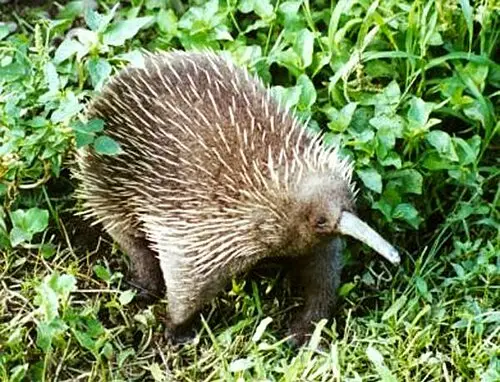
 📸 Photo
Photo: User:Jaganath · CC BY-SA 3.0 · Wikimedia Commons Source
Western Long-beaked Echidna
Zaglossus bruijnii (Western Long-beaked Echidna · ニシミユビハリモグラ)
💡 Everyday Comparisons for Size, Mass & Speed
- 💡 As an egg-laying mammal alongside the Platypus, it is a classic textbook example of a monotreme.
- 💡 After a specimen collected in 1901 in the Kimberley region of Western Australia was belatedly identified as this species, speculation continues that it might still survive in Australia.
Reference standards: coach bus ~12 m, mid-size car ~4.9 m, compact car ~1 t, basketball hoop 3.05 m, credit card 8.56 cm.
📖 1. Overview
The Western Long-beaked Echidna is an egg-laying mammal (monotreme) living in western New Guinea, with no wild records since the 1980s.
🦴 2. Anatomy & Morphology
It has three claws (rarely four) on each foot, and its fur color and spine color and density vary greatly among individuals. Most individuals are entirely black, while some are brown.
🔍 3. Ecology & Behavior
It appears to feed on earthworms and small arthropods in soil and rotting wood, and is mainly active at night. Because there is no separate breeding information for this species, its reproduction is presumed to be similar to that of close relatives.
🇰🇷 4. Connection to Korea
No direct record connecting this species to Korea has been found.
📚 Sources & References
- • IUCN Red List CR (2016) — https://www.iucnredlist.org/species/23179
- • IUCN Red List category CR — latest assessment at iucnredlist.org
- • mammaldiversity.org — 1000005
- • iucnredlist.org — 23179
- • wikidata.org — Q635949
- • commons.wikimedia.org — File:Long-beakedEchidna.jpg
- • tb.plazi.org — 03D84416066EFF91FFC5FE3922E9F681
- • animaldiversity.org — Zaglossus bruijni
- • Silhouette: PhyloPic — author not recorded · CC0 1.0 (Congeneric silhouette — Zaglossus bruijni)
Recorded dimensions are widely cited representative estimates from public literature and may vary by study or specimen.