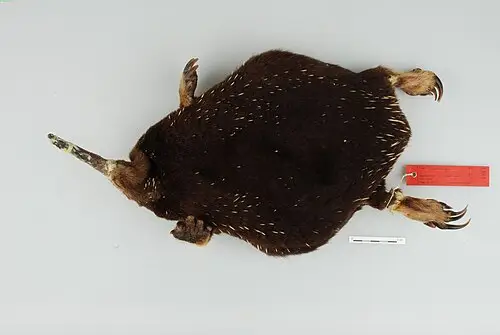
 📸 Photo
Photo: Naturalis Biodiversity Center · CC0 · Wikimedia Commons Source
Attenborough's Long-beaked Echidna
Zaglossus attenboroughi (Attenborough's Long-beaked Echidna · アッテンボローミユビハリモグラ)
💡 Everyday Comparisons for Size, Mass & Speed
- 💡 Its weight of 3 kg equals two 1.5 L bottles of water, and its length of 30 cm is similar to one student ruler (Comparison).
- 💡 In nearby villages, two people resolving a dispute may share an echidna meal together, or someone may be ordered as punishment to go into the mountains and find one.
Reference standards: coach bus ~12 m, mid-size car ~4.9 m, compact car ~1 t, basketball hoop 3.05 m, credit card 8.56 cm.
Site-computed relative index from recorded values; not a formal scientific metric.
📖 1. Overview
Attenborough's Long-beaked Echidna is an egg-laying mammal known only from the forests of the Cyclops Mountains and is the smallest of the long-beaked echidnas. Its IUCN assessment is Critically Endangered (CR).
🦴 2. Anatomy & Morphology
Its snout is about 70 mm long, straighter and shorter than that of other echidnas. It has 5 claws on each foot, males have a small non-venomous spur on the inside of the ankle, and its fur is short, dense, and brown.
🔍 3. Ecology & Behavior
Little is known about what it eats in the wild, but it is thought to feed on worms such as earthworms, and holes poked by its snout have been found. Its breeding habits are also poorly known.
🇰🇷 4. Connection to Korea
No direct record connecting this species to Korea has been found.
📚 Sources & References
- • IUCN Red List CR (2016) — https://www.iucnredlist.org/species/136322/21964353
- • IUCN Red List category CR — latest assessment at iucnredlist.org
- • mammaldiversity.org — 1000003
- • iucnredlist.org — 21964353
- • wikidata.org — Q757942
- • commons.wikimedia.org — File:Zaglossus attenboroughi Flannery.jpg
- • animaldiversity.org — Zaglossus attenboroughi
- • Silhouette: PhyloPic — author not recorded · CC0 1.0 (Congeneric silhouette — Zaglossus bruijni)
Recorded dimensions are widely cited representative estimates from public literature and may vary by study or specimen.