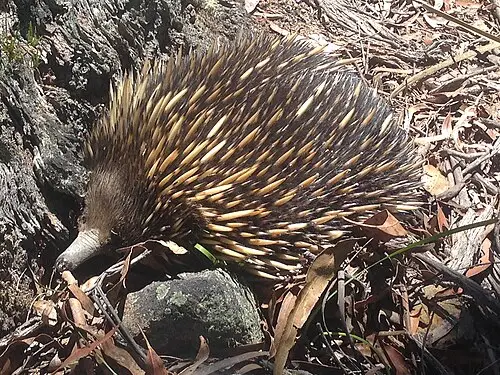
 📸 Photo
Photo: gabecollett · CC BY-SA 4.0 · Wikimedia Commons Source
Short-beaked Echidna
Tachyglossus aculeatus (Short-beaked Echidna · ハリモグラ)
💡 Everyday Comparisons for Size, Mass & Speed
- 💡 Its weight of 7 kg is about 7 tenths of a 10 kg bag of rice, and its length of 45 cm is slightly longer than the long side of an A3 sheet of paper (about 42 cm) (Comparison).
- 💡 By feeding on ants and termites it helps regulate insect numbers, and in New Guinea it is also hunted for food and ceremonies.
Reference standards: coach bus ~12 m, mid-size car ~4.9 m, compact car ~1 t, basketball hoop 3.05 m, credit card 8.56 cm.
Site-computed relative index from recorded values; not a formal scientific metric.
📖 1. Overview
The Short-beaked Echidna is an egg-laying mammal found across diverse habitats in Australia and New Guinea, covered in spines along its back and fond of eating ants and termites.
🦴 2. Anatomy & Morphology
Spines cover its entire back and small tail, and it lacks external ear flaps and teeth, having hard pads at the back of the mouth instead. Its tubular snout, long sticky tongue, and digging forepaws are well adapted for foraging.
🔍 3. Ecology & Behavior
It digs into ant and termite nests with its forepaws and laps up prey with its sticky tongue, leaving its feces mixed with plenty of soil. From early autumn to late spring it hibernates with its body temperature lowered to 8–10 degrees, and about 23 days after mating the female lays a single egg and incubates it in her pouch.
🇰🇷 4. Connection to Korea
No direct record connecting this species to Korea has been found.
📚 Sources & References
- • IUCN Red List LC (2016) — https://www.iucnredlist.org/species/41312/21964662
- • IUCN Red List category LC — latest assessment at iucnredlist.org
- • mammaldiversity.org — 1000002
- • iucnredlist.org — 21964662
- • wikidata.org — Q193182
- • animaldiversity.org — Tachyglossus aculeatus
- • Silhouette: PhyloPic — Caleb M. Gordon · CC0 1.0
Recorded dimensions are widely cited representative estimates from public literature and may vary by study or specimen.