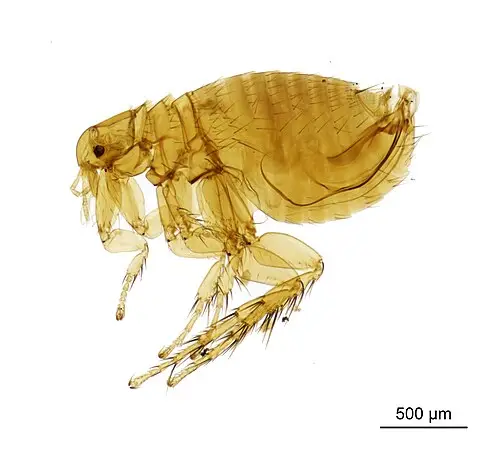
 📸 Photo
Photo: Olha Schedrina / The Natural History Museum · CC BY 4.0 · Wikimedia Commons Source
Oriental rat flea
Xenopsylla cheopis (Oriental rat flea · ケオプスネズミノミ)
Not Evaluated (NE) on the IUCN Red List yet.
💡 Everyday Comparisons for Size, Mass & Speed
- 💡 A body length of 4 mm is less than 1/4 the diameter of a Korean 10-won coin (18 mm) (Comparison).
- 💡 It is common around rat-infested seaports and urban sewer systems, and clothing, beds, and couches can also serve as its habitat (Animal Diversity Web).
Reference standards: coach bus ~12 m, mid-size car ~4.9 m, compact car ~1 t, basketball hoop 3.05 m, credit card 8.56 cm.
📖 1. Overview
The Oriental rat flea is a wingless flea that sucks the blood of rats and is found in cities and seaports where rats are abundant.
🦴 2. Anatomy & Morphology
Its body is flattened from side to side, light brown to dark brown, and wingless. Its hind legs are very large, storing energy in an elastic protein called resilin and releasing it in a single jump.
🔍 3. Ecology & Behavior
Both males and females feed on blood, biting mammals such as the black rat (Rattus rattus) as well as humans. It attaches to the host's body only while sucking blood and spends the rest of the time in the host's nest.
🇰🇷 4. Connection to Korea
It is listed as 'Yeoldaejwibyeoruk' (Korean name) in the National List of Species of Korea.
📚 Sources & References
- • IUCN Red List: not evaluated (NE) — cross-checked with the Wikidata conservation-status entry
- • catalogueoflife.org — 5CB97
- • 국가생물종목록(국립생물자원관) ktsn 120000038330 — https://species.nibr.go.kr/home/mainHome.do?cont_link=009&subMenu=009002&contCd=009002&ktsn=120000038330
- • wikidata.org — Q499106
- • commons.wikimedia.org — File:NHMUK010177265 The plague flea - Xenopsylla cheopis che
- • animaldiversity.org — Xenopsylla cheopis
- • Silhouette: PhyloPic — Graham Montgomery · CC BY 4.0 (Related taxon silhouette — Pulicidae)
Recorded dimensions are widely cited representative estimates from public literature and may vary by study or specimen.