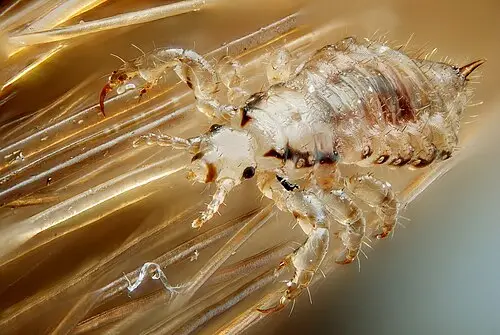
 📸 Photo
Photo: Gilles San Martin · CC BY-SA 2.0 · Wikimedia Commons Source
Human louse
Pediculus humanus (Human louse · ヒトジラミ)
Not Evaluated (NE) on the IUCN Red List yet.
💡 Everyday Comparisons for Size, Mass & Speed
- 💡 A maximum body length of 3.5 mm is about 1/5 the diameter of a Korean 10-won coin (18 mm) (Comparison).
- 💡 It can be transmitted through direct contact, clothing, brushes, or fallen hair, and wet combing with a fine-toothed comb is used together with medication (Animal Diversity Web).
Reference standards: coach bus ~12 m, mid-size car ~4.9 m, compact car ~1 t, basketball hoop 3.05 m, credit card 8.56 cm.
📖 1. Overview
The human louse is a wingless insect that lives solely by sucking human blood and can survive only a few days away from the human body.
🦴 2. Anatomy & Morphology
It is a small wingless insect with a large abdomen and sharp claws for gripping hair and clothing fibers. Its mouthparts are shaped to pierce skin and suck blood.
🔍 3. Ecology & Behavior
Eggs (nits) are attached singly to hair or clothing, and nymphs hatch after about 8 days. Nymphs also suck blood and become adults in 8–16 days.
🇰🇷 4. Connection to Korea
It is listed as 'I' (Korean name) on the National List of Species of Korea.
📚 Sources & References
- • IUCN Red List: not evaluated (NE) — cross-checked with the Wikidata conservation-status entry
- • catalogueoflife.org — 6TWLT
- • 국가생물종목록(국립생물자원관) ktsn 120000037872 — https://species.nibr.go.kr/home/mainHome.do?cont_link=009&subMenu=009002&contCd=009002&ktsn=120000037872
- • wikidata.org — Q3737588
- • commons.wikimedia.org — File:Male human head louse.jpg
- • animaldiversity.org — Pediculus humanus
- • Silhouette: PhyloPic — Jitte Groothuis (Jittebug Photography & Creations) · CC BY 4.0
Recorded dimensions are widely cited representative estimates from public literature and may vary by study or specimen.