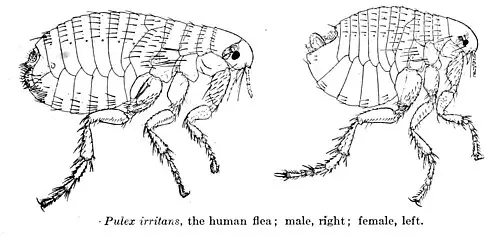
 📸 Photo
Photo: Herms, William Brodbeck (1876-1949) · Public domain · Wikimedia Commons Source
Human flea
Pulex irritans (Human flea · ヒトノミ)
Not Evaluated (NE) on the IUCN Red List yet.
💡 Everyday Comparisons for Size, Mass & Speed
- 💡 A maximum body length of 3.5 mm is smaller than a grain of rice (about 5 mm) (Comparison).
- 💡 An information booklet from the Korea Disease Control and Prevention Agency lists residential areas and companion animals as flea habitats, which is why flea control is a common topic in households with dogs and cats.
- 💡 A flea jumps over 30 cm in about 0.02 seconds—crossing twice the length of a smartphone (about 15 cm) in the blink of an eye (Comparison).
Reference standards: coach bus ~12 m, mid-size car ~4.9 m, compact car ~1 t, basketball hoop 3.05 m, credit card 8.56 cm.
📖 1. Overview
The human flea is a flea that sucks the blood of mammals including humans and is spread worldwide. Adults climb onto a host's body only to feed and usually live in the host's nest or inside human homes.
🦴 2. Anatomy & Morphology
Its body is reddish brown, laterally flattened, and wingless. Body length is 2.5–3.5 mm in females and 2–2.5 mm in males, and it jumps long distances thanks to the protein resilin in its swollen leg bases (coxae).
🔍 3. Ecology & Behavior
Adults must feed on blood to lay eggs; females lay 8–12 eggs at a time, which hatch 4–6 days later. Breeding can occur year-round, and a jumping flea travels over 30 cm in about 0.02 seconds.
🇰🇷 4. Connection to Korea
It is listed as 'Sa-ram-byeo-ruk' (Korean name) on the National List of Species of Korea by the National Institute of Biological Resources (NIBR), and the Korea Disease Control and Prevention Agency introduces fleas as insects living around residential areas and companion animals.
📚 Sources & References
- • IUCN Red List: not evaluated (NE) — cross-checked with the Wikidata conservation-status entry
- • catalogueoflife.org — 6WPPH
- • 국가생물종목록(국립생물자원관) ktsn 120000131199 — https://species.nibr.go.kr/home/mainHome.do?cont_link=009&subMenu=009002&contCd=009002&ktsn=120000131199
- • wikidata.org — Q989263
- • commons.wikimedia.org — File:PulexIrritans.jpg
- • animaldiversity.org — Pulex irritans
- • kdca.go.kr — download.do
- • Silhouette: PhyloPic — author not recorded · Public Domain Mark 1.0
Recorded dimensions are widely cited representative estimates from public literature and may vary by study or specimen.