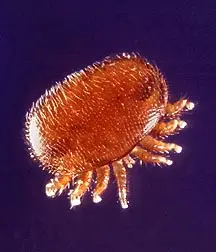
 📸 Photo
Photo: Public domain · Public domain · Wikimedia Commons Source
Varroa mite
Varroa destructor (Varroa mite · ミツバチヘギイタダニ)
Not Evaluated (NE) on the IUCN Red List yet.
💡 Everyday Comparisons for Size, Mass & Speed
- 💡 A female's maximum length of 1.77 mm is about 1/3 the length of a grain of rice (about 5 mm) (Comparison). Females have a flattened oval shape that is wider (up to 1.99 mm) than it is long.
- 💡 UF/IFAS describes this mite as the most destructive pest of the western honey bee. Western honey bee hives kept for honey production suffer the greatest damage from this mite.
Reference standards: coach bus ~12 m, mid-size car ~4.9 m, compact car ~1 t, basketball hoop 3.05 m, credit card 8.56 cm.
📖 1. Overview
The varroa mite is an external parasitic mite living on western honey bees and is considered the most damaging pest to western honey bees.
🦴 2. Anatomy & Morphology
Adult females are reddish-brown to dark brown and oval-shaped, measuring 1.00–1.77 mm in length and 1.50–1.99 mm in width. Males are yellowish, spherical, and smaller at 0.75–0.98 mm in length.
🔍 3. Ecology & Behavior
Females pierce the soft membrane between body segments of adult honey bees to feed on fat bodies, and reproduce only inside capped bee brood cells. Originally parasitic on the eastern honey bee (Apis cerana) in Asia, the mite spread worldwide after shifting hosts to the western honey bee.
🇰🇷 4. Connection to Korea
It is listed as 'Kkulbeol-eung-ae' (Korean name) in the National List of Species of Korea.
📚 Sources & References
- • IUCN Red List: not evaluated (NE) — cross-checked with the Wikidata conservation-status entry
- • catalogueoflife.org — 7X76D
- • 국가생물종목록(국립생물자원관) ktsn 120000046768 — https://species.nibr.go.kr/home/mainHome.do?cont_link=009&subMenu=009002&contCd=009002&ktsn=120000046768
- • wikidata.org — Q48564
- • commons.wikimedia.org — File:Varroa Mite.jpg
- • edis.ifas.ufl.edu — IN855.pdf
- • species.nibr.go.kr — mainHome.do
- • Silhouette: PhyloPic — author not recorded · CC0 1.0
Recorded dimensions are widely cited representative estimates from public literature and may vary by study or specimen.