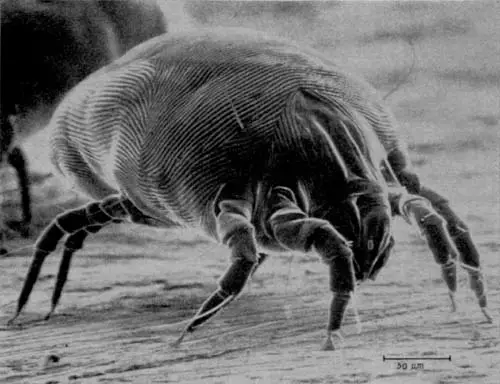
 📸 Photo
Photo: Employee of US Government · Public domain · Wikimedia Commons Source
European house dust mite
Dermatophagoides pteronyssinus (European house dust mite · ヤケヒョウヒダニ)
Not Evaluated (NE) on the IUCN Red List yet.
💡 Everyday Comparisons for Size, Mass & Speed
- 💡 The female body length of about 0.4 mm is smaller than the thickness of a 0.5 mm mechanical pencil lead (Comparison).
- 💡 Materials from the University of Florida (UF/IFAS) explain that a person sheds 0.5–1.0 g of skin flakes per day, which house dust mites feed on. Allergens are contained mainly in the mites' droppings, and when they become airborne they are linked to asthma, rhinitis, and atopic dermatitis.
Reference standards: coach bus ~12 m, mid-size car ~4.9 m, compact car ~1 t, basketball hoop 3.05 m, credit card 8.56 cm.
📖 1. Overview
The European house dust mite is a tiny mite living in household dust, distributed worldwide including throughout Korea.
🦴 2. Anatomy & Morphology
Females are 377–435 µm long and 212–247 µm wide, while males are 314–361 µm long. Most of the ventral body surface is covered with fine fingerprint-like patterns, and the tip of each foot bears a hemispherical sucker.
🔍 3. Ecology & Behavior
Indoors, it is known to feed on shed human skin flakes, and its life cycle takes 19–30 days. A female of this species lays about 80 eggs over 45 days, and if humidity drops below 60%, populations cannot grow and die out.
🇰🇷 4. Connection to Korea
It is listed as 'Se-ro-mu-nui-meon-ji-jin-deu-gi' (Korean name) on the National List of Species of Korea, which records its distribution throughout Korea.
📚 Sources & References
- • IUCN Red List: not evaluated (NE) — cross-checked with the Wikidata conservation-status entry
- • checklistbank.org — NDH4N
- • 국가생물종목록(국립생물자원관) ktsn 120000046452 — https://species.nibr.go.kr/home/mainHome.do?cont_link=009&subMenu=009002&contCd=009002&ktsn=120000046452
- • wikidata.org — Q4573411
- • commons.wikimedia.org — File:House Dust Mite.jpg
- • species.nibr.go.kr — mainHome.do
- • edis.ifas.ufl.edu — IN216.pdf
Recorded dimensions are widely cited representative estimates from public literature and may vary by study or specimen.